

What would it take to create a freshwater Tamar Lake that becomes Launceston’s new front door?
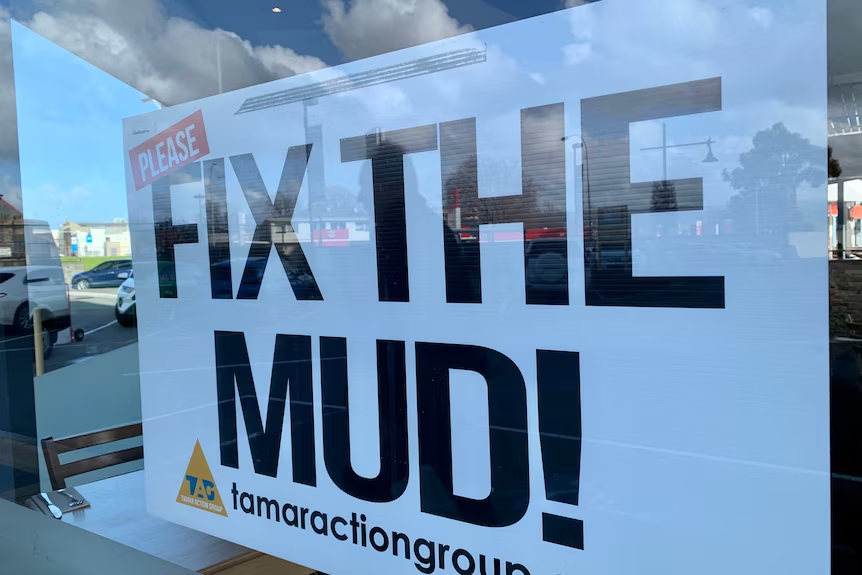
paul mallett advocates for building Tamar Lake as a generational investment in pride, place, and possibility. For decades the upper Tamar has shifted between mud, odour, and frustration. A freshwater lake would change that. A controllable barrage at Point Rapid would stabilise water levels, reduce exposed mud, and give the city a reliable, beautiful waterfront for the first time in generations.
Imagine a lake with a living edge: boardwalks, a small urban beach, paddling and swimming zones, public art, storytelling spaces, shaded lawns, and places to sit with a coffee while kids explore the shoreline. Imagine schools using the foreshore for outdoor learning, families meeting by the lake on weekends, clubs training on calm water, and visitors experiencing a waterfront the city is proud to show off.
Tamar Lake would be environmental repair, economic strategy, and community building at once. It would support industry certainty, attract visitors, improve daily life, and give Launceston a civic gathering place that feels welcoming and shared.
The aim is simple: a clean, safe, beautiful lake that restores confidence in the Tamar and becomes a new front door for our city.
Let’s build the lake we have talked about for generations, including:
1. Barrage and Permanent Freshwater Level
Construct a controllable weir/barrage at Point Rapid to convert the tidal reach into a stable freshwater lake.
• Creates year-round water amenity at a consistent river-edge level.
• Reduces fine-sediment resuspension and exposure of mudflats in the upper estuary.
• Provides long-term planning certainty for public infrastructure and private investment.
• Requires rigorous environmental assessment and full catchment modelling.
2. A City-Facing Lakefront
Design and build an activated lakefront that turns Launceston toward the water.
• Boardwalks, swimming/paddling zones, safe-entry beaches, café/market clusters.
• Sculpture, learning nodes, and Country-led interpretive spaces.
• Supports daily recreation, school programs, club activity, and family use.
• Lifts the city’s brand as a place to live, learn, and visit.
3. Water-for-Work: Economic Diversification
Use reliable freshwater to support irrigated agriculture and water-reliant industries across the valley and into Bell Bay.
• Enables horticulture expansion, food processing, and advanced manufacturing.
• Assists emerging hydrogen and clean-energy proponents needing water certainty.
• Creates resilience and workforce growth through diversified industry bases.
4. Flood and Level Management
Operate the barrage using a transparent hydrological regime.
• Potential to moderate certain flood peaks (subject to design and modelling).
• Faster post-flood recovery for selected areas due to stable water levels.
• Improves long-term resilience to sea-level rise scenarios.
• Requires statutory safeguards and independent oversight.
5. Culture, Memory, and Truth-Telling
Embed cultural interpretation and community history into the lake precinct.
• CitizenEcho storytelling nodes linking people, place, and memory.
• Public art and wayfinding designed with palawa/pakana leadership.
• Acknowledges Country, shared histories, and contemporary civic identity.
6. Catchment Honesty and Whole-System Stewardship
Pair the lake proposal with catchment-wide responsibility.
• Mudflats are natural estuarine features; a lake does not erase the system behind it.
• Invest in sediment management from source to sea.
• Fix sewage and stormwater overflows as a non-negotiable baseline.
• Avoid repeating the “dredge–re-silt–repeat” cycle by acting on root causes.