A more vibrant city requires careful financial stewardship.
To the people of Launceston,
Financial stewardship: ambition with discipline
I am ambitious for Launceston. I want us to invest in our streets and neighbourhoods, our parks and public spaces, our cultural institutions, better ways of moving around our city, opportunities for children and young people, a stronger city centre, and the infrastructure our community will need decades from now. But ambition with public money carries a responsibility. If we want to do big things, we also have to be disciplined about how we pay for them, how we measure them and how we account for the results.
Throughout this campaign I have tried to focus on listening carefully to our community, sharing the experience and ideas I can bring, and giving people enough information to make their own judgement when they vote. I also want to practise a kind politics. That does not mean avoiding difficult questions, scrutiny or disagreement. Good governance requires all three. But I do believe we can ask hard questions without turning everything into a fight, and we can challenge decisions without making politics about personalities, opponents or performative outrage. My focus is on the contribution I could make around the Council table and the kind of decision-making culture I would like to help strengthen.
Thirty years of managing public money
For around 30 years I have worked in community service across organisations including Anglicare Tasmania, The Smith Family, Oak Possability and Australian Red Cross. Over that time I have led hundreds of staff, worked in services supporting thousands of people, and carried responsibility across programs involving hundreds of millions of dollars in public, philanthropic and donated funds.
I say that with some caution, because none of that work was ever mine alone. It was done alongside frontline staff, managers, accountants, finance teams, chief financial officers, executives, boards, government partners and community organisations. Whatever experience I bring has been shaped by working with people who knew far more than I did in their own fields, and by learning that good financial management is always a team effort.
Community organisations also know what it means to work in financially constrained environments. There is rarely enough money to do everything that needs doing. Funding does not always keep pace with costs. Priorities compete. Every decision has consequences. You learn to budget carefully, monitor performance, ask good questions, listen to financial expertise and distinguish between spending that is merely desirable and investment that genuinely improves outcomes.
You also learn that the cheapest decision is not always the wisest one. Sometimes failing to invest today simply creates a much larger bill tomorrow.
One of nine around the table
If elected, I would be one of nine councillors around the table. I would not arrive believing I had all the answers. I would bring the experience I have, listen carefully to others, work constructively with fellow councillors and Council staff, and try to make a useful contribution to the collective responsibility of managing Council finances well.
For me, financial stewardship means being ambitious about what Launceston can achieve, disciplined about how we invest, careful with public money and transparent about the decisions we make. It also means recognising that good decisions are rarely the product of one person. They come from good information, thoughtful debate, capable staff, elected representatives willing to listen, and a community that can see how and why decisions have been made.
Public money is held in trust
Public money is held in trust. Whether it comes through rates, fees, borrowings, grants or other public funding, it ultimately belongs to the community. That should create a simple obligation: to be clear about what we are trying to achieve, what it will really cost, what alternatives have been considered, what risks are involved, what the community will receive in return and how we will know afterwards whether the investment worked.
Those questions should not be reserved for projects we oppose. They should be the ordinary discipline we apply to the ideas we support as well.
Look beyond the price tag
Good financial stewardship also means looking beyond the headline price. The true cost of major infrastructure can include planning, design, financing, construction, operation, maintenance, renewal and eventual replacement. It also includes opportunity cost: what else might we have done with the same resources?
The same depth of thinking should apply to benefits. Not every return to the community appears as revenue on a balance sheet. Safer streets have value. Better public spaces have value. Accessibility has value. Heritage, cultural life, opportunities for children and stronger neighbourhoods all have value. Preventing a problem before it becomes a crisis has value too.
Good financial management should be sophisticated enough to recognise both financial return and public value. It should allow us to be careful with money without becoming narrow in what we believe a city is for.
Partnership requires scrutiny
I want Launceston to work confidently with business, community organisations and other levels of government. Partnerships can help us achieve things that no single organisation could deliver alone, and our city will need that kind of collaboration if we are serious about its future.
But partnership should not reduce scrutiny. It should strengthen it. When public land, money, concessions or infrastructure form part of a project, we should understand what each party is contributing, who carries the risk, what public benefit is being created, what happens if circumstances change and how promised outcomes will be measured.
And when a major project changes substantially, I believe we should be willing to revisit the assumptions and business case. That is not about finding fault with decisions made in different circumstances. It is about being willing to learn, adjust and make the next decision better.
The cost of doing nothing
There is another side to financial stewardship that matters deeply to me: the cost of doing nothing. Much of my working life has involved seeing what happens when relatively small problems are allowed to become crises. Deferred maintenance becomes major reconstruction. Housing insecurity becomes homelessness. Poor accessibility increases isolation. Families who might have benefited from modest support earlier can later require much more intensive and expensive intervention.
This is the logic of prevention and what I have often described as failure demand. Sometimes the money we spend responding to crises is the price of failing to act sooner.
That is why prevention belongs in conversations about financial responsibility. It is not simply another cost competing for limited resources. In many circumstances, prevention is the financially responsible choice.
The posture I would bring
That is the financial posture I would bring to Council: invest where investment makes sense, maintain what we already own, consider whole-of-life costs, put prevention alongside remediation, understand risk before committing public resources, measure public value as well as financial return, revisit assumptions when circumstances change, ask difficult questions respectfully and report back openly about the results.
I would also bring some humility about the task. Council finances are complex. There will be decisions where I need to listen, learn and rely on the expertise of others. But I do know the discipline of managing scarce resources, working with financial professionals, balancing competing needs and trying to make decisions that hold up over time.
I want Launceston to be ambitious. I want us to think beyond the next budget cycle and invest carefully in the city we want to leave to those who come after us. Financial discipline is not the brake on that ambition. It is what gives a Council the credibility and capacity to be ambitious.
If we are going to ask our community to back big ideas for the future of Launceston, then we should also be prepared to show them the numbers, explain the risks, measure the benefits and account for the results. That is the standard I would try to bring to the Council table, alongside eight other elected representatives and the many capable people already serving this city.
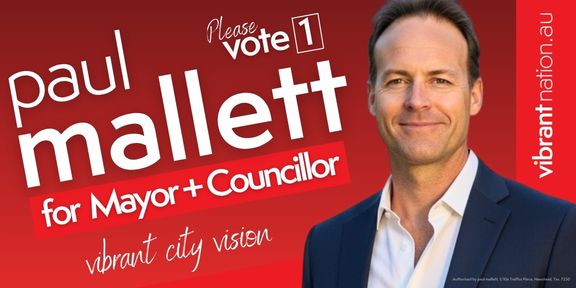
paul mallett
Candidate for Mayor and Councillor
City of Launceston
vibrantnation.au
Letter to the Editor
Dear Editor
I believe Launceston can be ambitious about its future and disciplined with public money at the same time.
For around 30 years I have worked across community services including Anglicare Tasmania, The Smith Family, Oak Possability and Australian Red Cross. Over that time I have led hundreds of staff, worked in services supporting thousands of people, and carried responsibility across programs involving hundreds of millions of dollars in public, philanthropic and donated funds.
None of that work was achieved alone. It involved frontline staff, managers, accountants, finance teams, chief financial officers, executives, boards, government partners and community organisations. Good financial management is collective work, and it depends on asking good questions, understanding risk and recognising that every dollar committed in one place cannot be spent somewhere else.
That experience has also taught me that financial responsibility does not simply mean spending less. Sometimes the cheapest decision today creates a much larger cost tomorrow. Deferred maintenance becomes major reconstruction. Problems that might have been prevented become expensive crises.
If elected, I would be one of nine councillors around the table. I would bring my experience, listen to others and contribute to the shared responsibility of managing Council finances carefully.
For me, that means looking beyond headline prices to whole-of-life costs, measuring public value as well as financial return, understanding risk before committing public resources, revisiting assumptions when circumstances change and being transparent with the community about what we spend, why we spend it and what we achieve.
Public money is held in trust. We should be ambitious about what Launceston can become, but equally serious about showing the numbers, explaining the risks and accounting for the results.
Financial discipline is not the brake on ambition. Done well, it is what gives Council the capacity and credibility to be ambitious.
paul mallett