paul mallett backs events precinct push and calls for Launceston to invest in the people who create its culture
Candidate for Mayor and Councillor paul mallett has welcomed the push for a dedicated events and festivals precinct in Launceston, while calling for a complementary investment in the artists, musicians and performers who will bring those spaces to life.
LAUNCESTON, TASMANIA, 20 September 2026: paul mallett has welcomed the proposal for a CBD events and festivals precinct, saying it aligns strongly with his call for Launceston to become a more creative city that celebrates.
But mallett said attracting major events and creating places for audiences to gather should be only one half of the ambition.
“Yes, let’s build the infrastructure that allows Launceston to attract bigger events, festivals and visitors. And let’s invest in the cultural infrastructure that allows people here to learn, practise, rehearse, create and perform.”
“If we want the stages, we also need to invest in the people who will stand on them.”
mallett said the proposal strengthens the case for a purpose-built Performing Arts Centre offering affordable and accessible rehearsal, practice, creative and performance spaces for local musicians, choirs, theatre groups, dancers, visual artists and community organisations.
An events city needs artists
mallett said Launceston should think about cultural infrastructure in the same way it thinks about sporting and recreational infrastructure.
“Launceston has rightly invested over many years in places where people can play sport, exercise, train and come together through recreation. Those investments contribute enormously to the life of the city.”
“I think it is time we brought that same civic ambition to the creative city.”
He said an events economy cannot simply rely on importing performers and productions from elsewhere.
“A creative city has to grow creativity locally. Talent does not suddenly appear when the festival lights go on. It develops in rehearsal rooms, studios, classrooms, community bands, choirs, theatre groups and small performances over many years.”
“If we want Launceston to be known for music, festivals, theatre and creativity, we have to give people somewhere affordable to learn and practise the arts in the first place.”
Upstream investment in connection and belonging
mallett said investment in the arts should also be understood as upstream social investment, not simply cultural expenditure.
“This is about much more than producing the next musician or actor. The arts bring people together across generations. A choir, community band, theatre group, dance class or art studio can connect an older person with someone fifty years younger.”
“Those relationships matter. They build belonging, interrupt loneliness and give people reasons to remain active and connected to community throughout their lives.”
“That is upstream investment. It is investment in social connection before loneliness becomes isolation, in wellbeing before distress becomes crisis, and in belonging before people become disconnected from community.”
mallett said this was particularly important in a city with an ageing population.
“One of the most powerful things about community arts is that they do not divide people neatly by age. Teenagers can play music alongside people in their seventies. Children can perform with grandparents. People can continue learning, teaching, creating and contributing throughout life.”
“That is exactly the kind of intergenerational city I want Launceston to become.”
Boag’s, or a new cultural precinct at the Railyards
mallett said his preferred option remained incorporating a Performing Arts Centre into a redeveloped Boag’s precinct, alongside events, civic and community uses.
But he said the proposal should not depend on a single site.
“If we can deliver this as part of a redeveloped Boag’s precinct, terrific. But if that opportunity does not materialise, then let’s land it beside QVMAG and UTAS at the Railyards.”
“That could create something equally exciting: a genuine walkable arts and cultural precinct stretching through the heart of Launceston.”
mallett said a Railyards location would place a new Performing Arts Centre alongside QVMAG and the University of Tasmania, and within an easy walk of Albert Hall and the Princess Theatre.
“Imagine that cultural spine through the city: the Princess Theatre, Albert Hall, QVMAG, UTAS and a purpose-built home for community arts, all within roughly a mile’s walk.”
“That is what a walkable creative city can look like. Not one isolated building, but a connected cultural precinct where learning, making, exhibiting, rehearsing and performing reinforce one another.”
Make it shovel-ready and take the case to government
mallett said a Performing Arts Centre of regional significance should not be expected to be funded by the City of Launceston alone.
“Council cannot and should not carry the full cost of major cultural infrastructure by itself. This has to become part of Launceston’s advocacy package to State and Commonwealth governments.”
He said the practical task for the next Council should be to move the idea beyond aspiration by undertaking the planning, consultation, site assessment, design work, business case and costings needed to create a credible, shovel-ready project.
“Let’s do the work now so that when the next State or Federal election comes around, Launceston is not turning up with an idea on the back of an envelope. We should be able to put a developed project on the table and say: this is what our city needs, this is where it can go, this is what it will deliver, and this is the partnership we are asking you to join.”
mallett said Launceston had already demonstrated that local government could help secure larger investments by developing a strong local case and advocating for partnership funding.
“We have rightly sought State and Commonwealth investment to help build and redevelop sporting and recreational infrastructure. Cultural infrastructure should be approached with the same ambition.”
“Council’s role is to lead the local conversation, build the evidence, prepare the project and advocate. Then we ask State and Commonwealth governments to co-invest with us in building the city.”
Affordable places to learn, practise and perform
mallett said conversations with local musicians had reinforced the shortage of affordable rehearsal and performance spaces in Launceston.
“Our city has talented musicians, performers and community arts groups. What we do not have enough of are affordable, accessible places for them to practise.”
“A magnificent performance venue that local bands, choirs or theatre groups cannot afford to use does not solve that problem.”
He said affordability, accessibility and flexible rehearsal space should therefore be central to the design.
“The purpose is not simply to build another theatre. It is to build the ecosystem underneath the performance: places to practise, collaborate, teach, learn, rehearse and make things.”
Yes to events, and yes to the creative city
mallett said the events precinct proposal should be seen as an opportunity to broaden Launceston’s cultural ambition.
“My response is very much: yes, and.”
“Yes to an events precinct. Yes to bigger festivals. Yes to more visitors. Yes to activating our CBD.”
“And yes to rehearsal rooms. Yes to studios. Yes to affordable performance space. Yes to community arts. Yes to investing in the people who will create the culture those venues depend upon.”
“We have built sporting complexes because we understand that people need places to train before they compete. The arts are no different. People need somewhere to learn and practise before they perform.”
“A creative city cannot simply consume culture. It has to cultivate it.”
Proposal summary
- Support development of a CBD events and festivals precinct.
- Establish a complementary Performing Arts Centre with affordable rehearsal, practice, creative and performance spaces.
- Pursue the Boag’s precinct as one potential location.
- If Boag’s cannot accommodate it, investigate a site adjacent to QVMAG and UTAS at the Railyards, creating a walkable cultural precinct connecting QVMAG, UTAS, Albert Hall and the Princess Theatre.
- Provide affordable facilities for musicians, choirs, theatre and drama groups, dancers, visual artists and community arts organisations.
- Make universal accessibility and community affordability core design requirements.
- Treat arts infrastructure as upstream investment in social connection, belonging, healthy ageing and prevention of loneliness.
- Create opportunities for intergenerational participation in music, theatre, visual arts and other creative activity.
- Give arts and cultural infrastructure comparable civic ambition to the investment Launceston has rightly made in sport and recreation.
- Develop the proposal through consultation, site assessment, concept design, business case and costings so Launceston has a shovel-ready project to take into future State and Federal election advocacy.
- Seek a funding partnership between the City of Launceston, Tasmanian Government and Australian Government rather than expecting local ratepayers to fund infrastructure of regional significance alone.
“When I talk about a creative city that celebrates, this is what I mean,” mallett said.
“Build the places to celebrate. Build the places to create. Build the places where an older person and a young person can learn from one another, where local talent can grow, and where people can remain connected to community throughout their lives.”
“We have invested in the sporting city. Now let’s invest with the same ambition in the creative city.”
[ends]
Note to editors: The candidate’s name, paul mallett, is styled in lowercase deliberately and should be reproduced as written. This is not a typographical error.
About the candidate
paul mallett is a Launceston-based social policy author, systems thinker, and community services leader with more than thirty years of experience across homelessness, housing, children and family services, disability, aged care, early learning, and the care economy.
He is the author of vibrant city, a story of Launceston’s future told from 2064, a community leader looking back across four decades of change alongside a young data guardian verifying his account. Chapter by chapter, it imagines a Launceston that works, cares, moves, lifts its kids, creates and celebrates, and grows as a city in a garden. He proposes creating a freshwater Tamar Lake, a second river crossing built for walking and cycling from day one, a cradle-to-career system for every child, and a city-wide movement for health and belonging. It is not a fantasy of a perfect city. It is a civic provocation, a way of asking whether the place we already love could become fairer, kinder, more confident, and more vibrant.
He is also the author of vibrant state, vibrant nation, The Kind Politics Playbook, Lives Worth Staying For, and the Vibrant Leadership Series of policy blueprints: A State of Good Health, A Home for Everyone, Affordable Warmth, Every Child Succeeds, and “It’s the Care Economy, Stupid!”. He founded vibrantnation.au to share practical reform ideas for more vibrant communities.
Media enquiries
paul mallett
Email: paul.mallett@vibrantnation.au
Mobile: 0450 24 24 24
Website: vibrantnation.au
Location: Launceston, Tasmania
Letter to the Editor
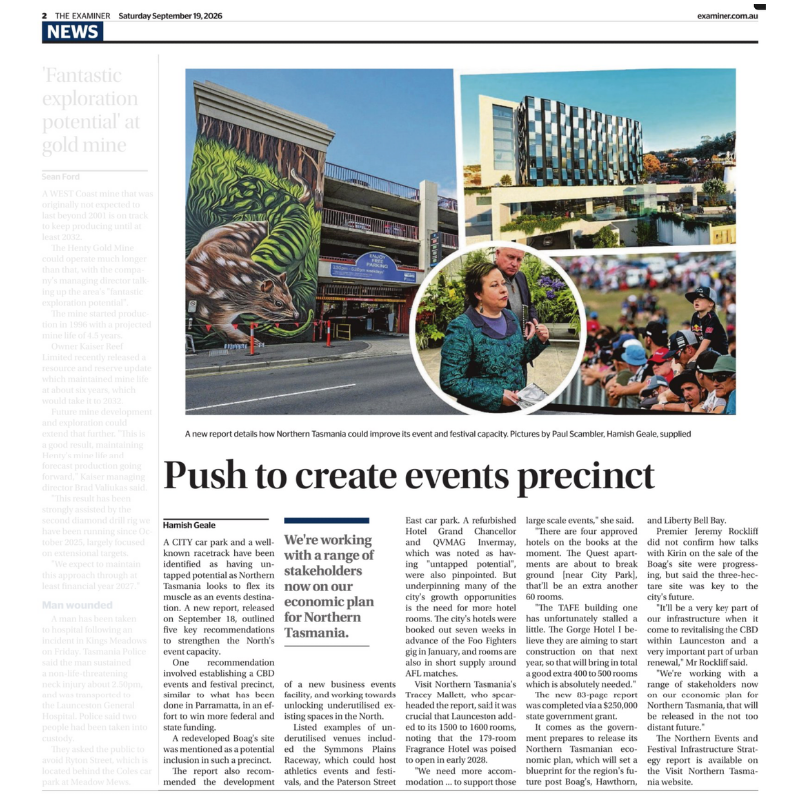
In reply to “Push to create events precinct” by Hamish Geale (The Examiner, 19 September 2026).
Dear Editor
As candidate for Council and Launceston Mayor, I welcome the push for a dedicated events and festivals precinct in Launceston. My response is simple: yes, and.
Yes to bigger events, festivals and visitors. And yes to investing in the local artists, musicians and performers who will bring those spaces to life.
If we want the stages, we also need affordable places where people can learn, practise, rehearse, create and perform. Launceston has rightly invested in sporting and recreational infrastructure for generations. I believe it is time to bring that same ambition to the creative city.
This is also upstream social investment. Community arts connect generations, interrupt loneliness, support healthy ageing and give people reasons to stay active and involved in the life of the city.
A purpose-built Performing Arts Centre could form part of a redeveloped Boag’s precinct. If that opportunity is not available, we should explore locating it beside QVMAG and UTAS at the Railyards, helping create a walkable cultural spine linking the Princess Theatre, Albert Hall, QVMAG, UTAS and a new home for community arts.
Council cannot fund major cultural infrastructure of this scale alone. The practical job now is to do the planning, consultation, site work, business case and costings so Launceston has a shovel-ready proposal to take to State and Commonwealth governments as part of our future election advocacy.
A creative city cannot simply consume culture. It has to cultivate it.
paul mallett
Prospective Candidate for Mayor and Councillor, City of Launceston
vibrantnation.au