Prepared statement by paul mallett
Candidate for Mayor and Councillor | City of Launceston
Launceston Chamber of Commerce Mayoral Debate | 5 October 2026
A more vibrant Launceston
I love Launceston: its people, this place and its potential. I want a city that gets the basics right while retaining the confidence to think big, that makes it easier for good businesses to invest and grow, builds the workforce its future requires, invests in children early and sustains that investment, creates more homes and stronger neighbourhoods, moves more easily, celebrates creativity, cares for its most vulnerable people, restores its relationship with kanamaluka / Tamar and becomes greener with every generation.
I want a Council that works constructively with business, community, neighbouring councils and other governments to turn those ambitions into practical results. The work is not about one Mayor. It is about bringing people together, doing the little things well, getting the big things done, and leaving Launceston stronger than we found it.
Decades Serving our Community
I am standing for Mayor and Councillor drawing on thirty years of community leadership, social policy work and practical experience bringing people together to solve difficult problems. My approach is to get the street-level basics right, use public money carefully, make it easier for people and businesses to deal with Council, build on what already works, be honest about what does not, and bring people together to get the big things done.
I do not see Launceston’s challenges as isolated issues. Housing affects workforce participation. Care affects whether people can work. Transport affects access to jobs, education, services and customers. Planning affects investment and housing supply. Culture and events affect visitation and the city centre. Childhood development affects the workforce we will have twenty years from now. The health and future of kanamaluka / Tamar affects amenity, investment, recreation, tourism and the identity of our city. Good local government needs to understand these connections rather than treating every issue as a separate silo.
Build on the good work already in motion
The City of Launceston Strategic Plan 2025–2035 provides a strong foundation. Its three pillars, Prosperity, Place and People, speak to many of the priorities I share, including economic development, housing, transport, inclusion, health and wellbeing, community participation, culture, sustainability and the quality of our neighbourhoods. Good leadership respects the work already done, acknowledges the people who contributed to it and builds from there.
Strategic plans must also evolve. Conditions change, evidence changes and communities change. A new Council should be prepared to ask where the existing plan remains strong, where implementation needs greater discipline, and where new evidence or opportunities justify raising the ambition. The Northern Economic Plan and the Launceston Chamber of Commerce priorities add another layer, emphasising investment, business confidence, housing, infrastructure, workforce, connectivity, regional cooperation and a city centre where people want to spend time and money. There is substantial common ground to build upon.
Financial stewardship: ambition with discipline
Ratepayers expect Council to use their money carefully. My approach is spend well. Before committing public money, I want Council asking what problem we are trying to solve, whether Council is the right organisation to solve it, what alternatives have been considered, what the whole-of-life cost will be, what outside funding can be leveraged, what happens if we do nothing, and what measurable public value the investment is expected to create.
Across thirty years of leadership I have managed hundreds of staff, services supporting thousands of people, and programs involving hundreds of millions of dollars. That experience has taught me that ambition and financial discipline are not opposites. We should pursue genuine efficiencies, examine shared services and joint procurement with neighbouring councils where these produce demonstrable savings, expect major Council activities to explain their public value, and be able to tell ratepayers clearly why any increase in rates, fees or charges is necessary. The standard should be responsible stewardship, transparent decisions and accountability for results.
Help make Launceston Council the easiest council to work with in Tasmania
Business does not need Council to guarantee success, but it should expect Council not to create unnecessary barriers to it. I support clearer service standards, published approval timeframes, transparent reporting against those timeframes, simpler processes where duplication can be removed, clear points of contact and earlier communication with businesses when Council decisions may affect access, parking, trading conditions or regulatory obligations.
Planning must protect the long-term public interest, but predictability matters. Businesses, developers, residents and community organisations should know what is required of them, how long decisions are likely to take and who they can speak to when something stalls. Good regulation should be proportionate, understandable and timely.
Grow the care economy as the foundation of the whole economy
I welcome the ambition in the Northern Economic Plan to make Northern Tasmania one of Australia’s leading regional economies. Advanced manufacturing, renewable energy, agriculture, food and beverage, tourism, maritime industries, technology, artificial intelligence and the blue economy all present significant opportunities for the North. I believe, however, that one major economic sector needs much greater attention: the care economy.
Health care, early learning, disability, aged care, allied health, mental health and community services employ thousands of people across Launceston and Northern Tasmania. More importantly, the care workforce enables other workforces to function. Without an early learning educator, a parent may not be able to work. Without adequate aged care, a family member may reduce their hours or leave employment to care for an ageing parent. Without disability and community services, people can be denied opportunities to participate fully in work and community life. Care is not something sitting beside the economy. It is part of the infrastructure underneath it.
The Northern Economic Plan proposes a Regional Workforce Plan and identifies the need for thousands of additional workers. I welcome that direction, and I will propose that the care workforce be named explicitly as a major regional workforce priority. I would advocate for a dedicated Northern Care Workforce Strategy, bringing together TasTAFE, the University of Tasmania, employers, community organisations, health and care providers, schools, neighbouring councils and State and Commonwealth governments.
The questions should be practical. How many workers will we need in five, ten and twenty years? Which occupations face the greatest shortages? What training pathways are missing? How do we create earn-while-you-learn opportunities? How do we improve supervision and early-career support? How do we retain people after we train them? A workforce report is not a workforce pipeline. We need to train people here, employ them here and give them good reasons to stay here.
A City Deal for Kids: Let’s build the next generation
Economic development also begins much earlier than we usually acknowledge. The children entering kindergarten and primary school today will be the workers, business owners, professionals, tradespeople, carers, artists and community leaders of the 2040s and 2050s. Too many children in Launceston begin school developmentally vulnerable. Those children are no less capable, talented, creative or ambitious than other children. Too often they simply begin with fewer buffers around them.
That is why I have proposed a City Deal for Kids: a cradle-to-career commitment bringing governments, schools, early learning, community organisations, business and families together around a simple goal that every child gets the strongest possible start and that support is sustained through the major transitions into school, adolescence, further education, training and work. A strong start that disappears at the next transition is investment squandered. If we want the workforce of twenty years from now, we have to invest in the children growing up here today.
Housing is economic infrastructure
Housing is not only a social issue. It is an economic constraint. Businesses cannot recruit and retain workers if those workers cannot find somewhere affordable to live. Young people cannot easily stay in the region if they cannot establish a home. Families under severe housing stress have less capacity to participate in the wider economy.
Local government does not control the housing system, but it has important levers. Council can improve planning processes, facilitate appropriate density, support inner-city living, identify underused land and buildings, work with the State on surplus public land, strengthen regional planning and advocate for the social and affordable housing the region needs. I also believe we need an honest conversation about short-stay accommodation, persistently vacant housing and whether rates, levies or other mechanisms could help return more existing homes to long-term residential use. Housing supply, homelessness prevention, workforce and economic development belong in the same conversation.
A stronger city centre
I want central Launceston to be a place more people live in, work in, move through, meet in, shop in, eat in and enjoy. That requires more inner-city residents, better use of vacant and underused buildings, a healthy mix of retail, hospitality, professional services, culture and entertainment, good public spaces, events that bring people into the city, safe and attractive streets, practical parking and access, better public transport, strong walking and cycling connections, and planning settings that encourage appropriate investment.
Upper-floor activation deserves serious attention, as does the reuse of vacant buildings and spaces. The city centre should not be thought about only from nine to five. A stronger residential population, hospitality economy, cultural program and events calendar can bring life into the centre across more hours and more days of the week. A creative city is not decoration added after the serious economic work is finished. Culture, hospitality, events, markets, museums, public spaces and the stories we tell about our city are part of how regional places attract residents, visitors, workers and investment.
A city that moves
Transport is an economic issue, a health issue and an inclusion issue. People need reliable ways to get to work, education, shops, services and community life. Businesses need customers, workers and freight to move efficiently. A growing city needs a transport system that provides more choices rather than assuming every additional trip must be made by car.
I support improving public transport, walking and cycling while recognising that cars and parking will remain important to Launceston for a long time. This should not become an ideological argument between cars and everything else. The objective is a better connected city. I also continue to support serious investigation of a second Tamar crossing because a new crossing could improve freight movement, reduce congestion, strengthen resilience and open new opportunities for the way Launceston grows. A bridge should move a city, not just cars.
kanamaluka / Tamar
Launceston grew around its waterways, yet we have never fully realised their potential. The future of kanamaluka / Tamar should be treated as a major environmental, economic, recreational and civic question. I support continued investigation of the freshwater Tamar Lake proposal, including the engineering, environmental, flood mitigation, water security, agricultural, recreational, tourism and economic questions that would determine whether it is feasible.
I do not pretend a Mayor can simply decree a project of that scale into existence. It would require rigorous studies, public scrutiny, Aboriginal engagement, environmental assessment, business cases, community consent and significant State and Commonwealth involvement. But leadership includes being willing to investigate generational opportunities properly. Some Council decisions are about the immediate term, while others are about what kind of city future generations will inherit. We need to be capable of doing both.
Build the big things, and build people with them
When we make major public investments, I want us to think about both the splash and the ripple. The splash is the construction activity, jobs, procurement, apprenticeships and spending generated while something is being built. The ripple is what that investment continues to give back ten, twenty or fifty years later.
A bridge, convention centre, sporting facility, cultural precinct, waterfront project or major housing development should not leave behind only concrete and steel. Where possible, major projects should also leave behind apprentices, qualified tradespeople, local businesses with stronger capability and young people who received a genuine first opportunity. Build the project, build the workforce and build social mobility at the same time.
A city that cares
I want Launceston to be economically ambitious without losing sight of people who are doing it tough. My report, The State of Our Most Vulnerable People 2027, brings together evidence across homelessness, housing stress, children and young people, disability, mental ill-health, energy hardship, family violence, socioeconomic disadvantage, older people, carers and other groups experiencing vulnerability.
The underlying lesson is consistent: too much public policy arrives after harm has become crisis. I favour a prevention-first approach. That does not mean Council takes over hospitals, housing, education or social services. It means Council understands the conditions it can influence, uses its convening and advocacy power, partners intelligently with other governments and asks where earlier action could prevent greater harm later. We pay either way. The question is whether we invest upstream in the things that keep people well, housed, connected and participating, or pay more downstream when preventable problems have become crises.
A city in a garden
I want Launceston to become greener with every generation. The City already has a target of increased tree canopy and better access to green space. I support that direction and want us to think beyond one planning cycle. Trees planted today will shade streets decades from now, and a long-term canopy strategy should prioritise the neighbourhoods with the least shade, connect parks and walking routes, improve biodiversity, reduce urban heat and make everyday physical activity more attractive.
I also support expanding community gardens, edible landscapes and neighbourhood-scale greening. A city in a garden is not simply about appearance. It is health infrastructure, climate infrastructure, biodiversity infrastructure and neighbourhood infrastructure.
My leadership approach
My career has been built on relational work, collaboration, co-design and implementation. I bring people together, look for whose voice is missing and seek to invite them in. I work to make sure the loudest voice does not automatically become the most important voice, and that quieter people around the table have room to contribute. I value professional expertise, lived experience, community knowledge, business experience and the practical wisdom of people who will ultimately have to implement a decision.
That is the leadership approach I set out in The Kind Politics Playbook. Kind politics does not mean being soft or avoiding difficult decisions. It means using power with care and purpose, listening properly, being honest about disagreement, treating people with dignity, using evidence, making decisions transparently and then taking responsibility for getting things done.
Collaboration is not an excuse for endless discussion. My instinct is to move a group from asking what we can do to determining what we will do, who will do it, by when, and how we will know whether it worked. That movement from conversation to commitment to implementation has been central to my working life.
One of nine around the table
If elected Mayor, I would still be one of nine councillors around the Council table. A Mayor does not own Council and cannot simply direct eight other elected representatives. Good ideas require support. Councillors bring different perspectives, Council staff bring professional expertise and institutional knowledge, businesses and community organisations hold knowledge that does not sit inside Town Hall, neighbouring councils share our regional economy, and State and Commonwealth governments hold many of the largest policy and funding levers.
The Mayor’s role is therefore not simply to have ideas. It is to help create the conditions in which good ideas can become shared priorities and shared priorities can become action. I would seek to lead with calm authority; respectfully and collaboratively, acknowledge good work already underway, give credit generously, ask difficult questions without making disagreement personal, own mistakes, seek first to understand, and keep bringing people back to the outcome we are trying to achieve.
The policy work behind my candidacy
Before standing for election, I chose to put my thinking into the public domain. The State of Our Most Vulnerable People 2027 is my evidence report. Our Almost Nearly Perfect Vibrant City sets out my local government platform around six connected themes: a city that works, a city that cares, a city that moves, a city for kids, a creative city that celebrates, and a city in a garden. The Kind Politics Playbook sets out the leadership methods and philosophy I would bring to public office. It’s the Care Economy, Stupid! develops the case for treating care and the care workforce as essential economic and social infrastructure, while my wider policy work addresses housing, health, children, energy hardship, suicide prevention and the systems that shape whether people and communities thrive.
I published that work because I believe people should be able to see what sits behind a candidate before they vote. People can read it, question it, challenge it, agree with some of it and disagree with other parts. What matters is that the evidence, values, policies and leadership approach I would bring to Council are visible in advance.
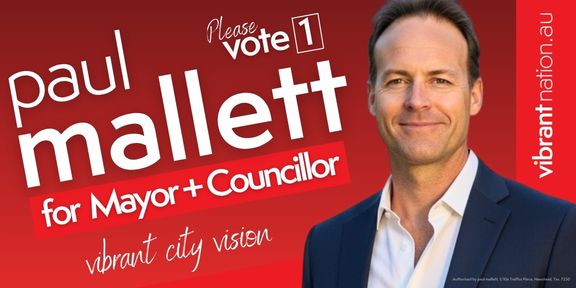
paul mallett
Candidate for Mayor and Councillor
City of Launceston
vibrantnation.au