
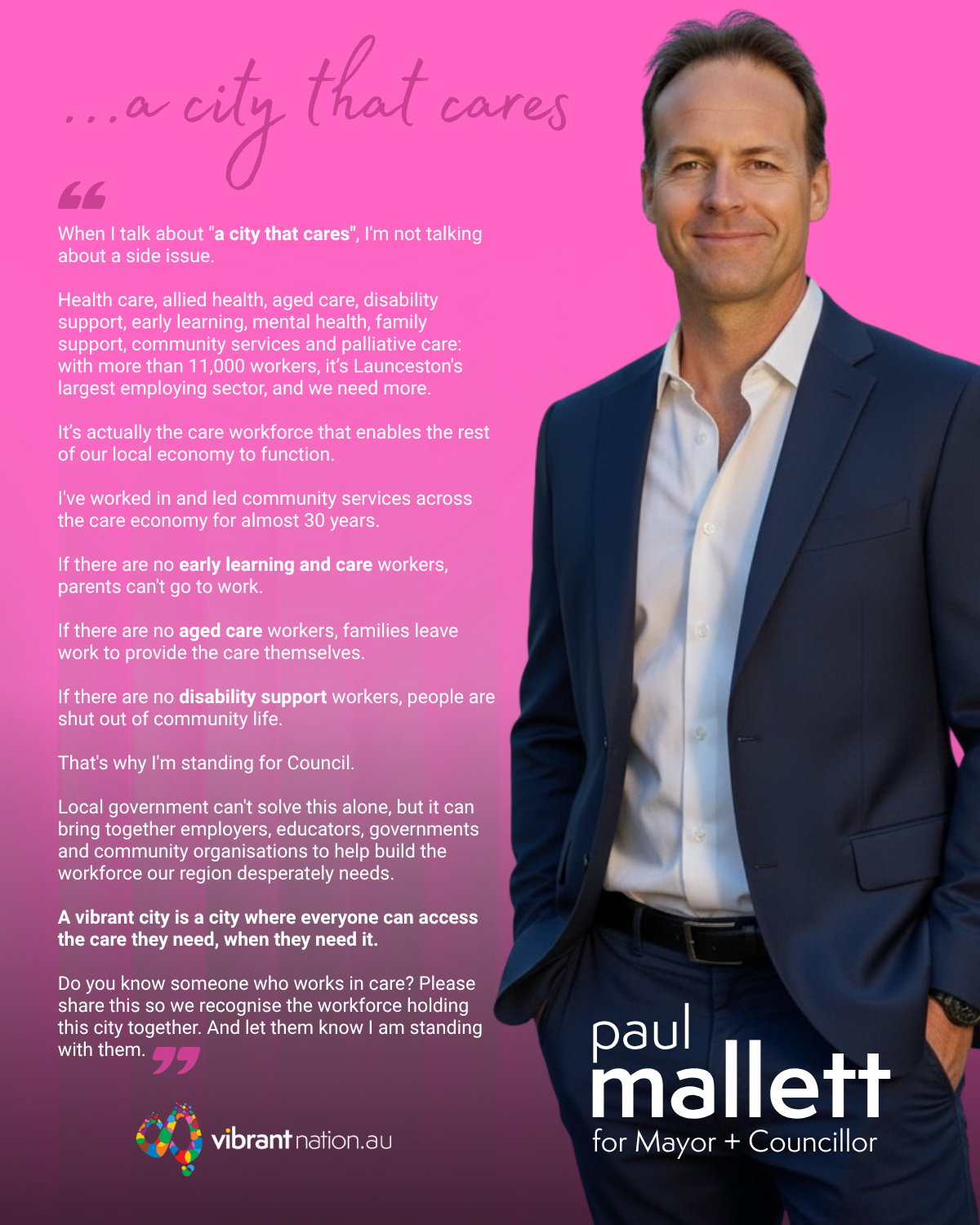
I believe care is essential economic infrastructure, every bit as fundamental to a functioning economy as roads, energy, water and technology.
I believe care is essential economic infrastructure, every bit as fundamental to a functioning economy as roads, energy, water and technology.
To the people of Launceston,
More than 11,000 people work in Launceston’s care economy. That is nearly one in four of our city’s workers. And we urgently need more.
The Northern Tasmania Economic Summit report is a welcome contribution to our region’s future. It recognises health and education as economic drivers, supports expanded health training, identifies housing and workforce attraction as foundations for future prosperity, and records the idea that social infrastructure should be viewed as economic infrastructure.
But the wider care economy remains largely unnamed, despite requiring significant planning and investment.
Care is essential economic infrastructure, every bit as fundamental to a functioning economy as roads, energy, water and technology.
That is the argument I make in my book, It’s the Care Economy, Stupid!, and it is an argument Northern Tasmania needs to take seriously as we plan our economic future.
Care makes the rest of the economy possible
The care economy includes the people who support us at the beginning of life, through illness and disability, during periods of vulnerability and as we age. It includes health, early learning and care, disability support, aged care and community services. It also includes the enormous amount of unpaid care provided by families and communities.
This work does much more than provide services to individuals. It enables people to work, learn and participate.
Parents cannot work without early learning and care. Workers reduce their hours or leave employment when disability, health or aged-care gaps require families to provide unpaid support. Delayed healthcare can push manageable conditions towards crisis and make it harder for people to remain in employment.
When formal care is unavailable, the need does not disappear. The work is transferred to families through unpaid care, reduced employment, lost income and exhaustion.
That has consequences across the economy.
A new manufacturing project needs workers, but those workers and their families also need healthcare, early learning and care, disability support, aged care and community services. Tourism needs a healthy and available workforce. Population growth requires services capable of supporting people throughout their lives.
Economic strategies that seek to attract more workers without planning the care infrastructure those workers and their families require are incomplete.
The workforce challenge is already here
More than 11,000 people already work in Launceston’s care economy. Nearly one in four workers. And we need more.
Demand across health, early learning and care, disability support, aged care and community services is growing. At the same time, experienced workers are retiring and services are competing for workers from the same regional labour market.
This cannot be solved by recruitment campaigns alone.
We need to think about the whole workforce pipeline: how people discover care careers, how they train, where placements occur, whether students can afford to complete those placements, whether new workers receive adequate supervision and mentoring, whether there are genuine career pathways, and whether workers can find suitable housing and transport.
These are interconnected workforce problems and they require an interconnected response.
Training also takes time. We cannot wait until shortages become deeper crises and then expect universities, TasTAFE, employers and communities to produce experienced workers overnight.
We need workers urgently now, and we need to be building the workforce Northern Tasmania will require into the 2030s and beyond.
A Regional Care Workforce Plan
That is why I am calling for the City of Launceston to urgently convene councils, care providers, workers, unions, educators, governments and community organisations to develop a Regional Care Workforce Plan for Northern Tasmania.
Council does not control every workforce lever, and no organisation can solve this challenge alone. But Council can bring people together.
A Regional Care Workforce Plan could connect projected workforce demand with university, TasTAFE and school pathways. It could examine training and placement capacity, supervision and mentoring, career progression, housing and transport barriers, and stronger pathways into lasting care careers.
It could identify what needs to happen locally, what requires State Government action, what requires Commonwealth investment, and where employers, educators and community organisations can work together.
The purpose should not be another report sitting on a shelf. It should be a practical regional workforce plan with responsibilities, commitments and progress that can be measured.
Social infrastructure is economic infrastructure
One of the most important ideas recorded in the Northern Tasmania Economic Summit report is the suggestion that we should view social infrastructure as economic infrastructure when planning for the future. Care is exactly that.
Northern Tasmania should continue pursuing growth in manufacturing, renewable energy, agriculture, tourism, technology and other industries. Those opportunities matter. But every one of those industries depends on people being healthy, supported and available to participate.
We understand that economic growth requires roads. It requires energy. It requires water. It requires technology.
It also requires care.
The care economy is not a burden carried after economic growth has occurred. It enables the whole economy to function.
By working together now, we can build the care workforce Northern Tasmania urgently needs today, into the 2030s and beyond.
With thanks,
paul mallett
Prospective Candidate for Mayor and Councillor, City of Launceston
vibrantnation.au