
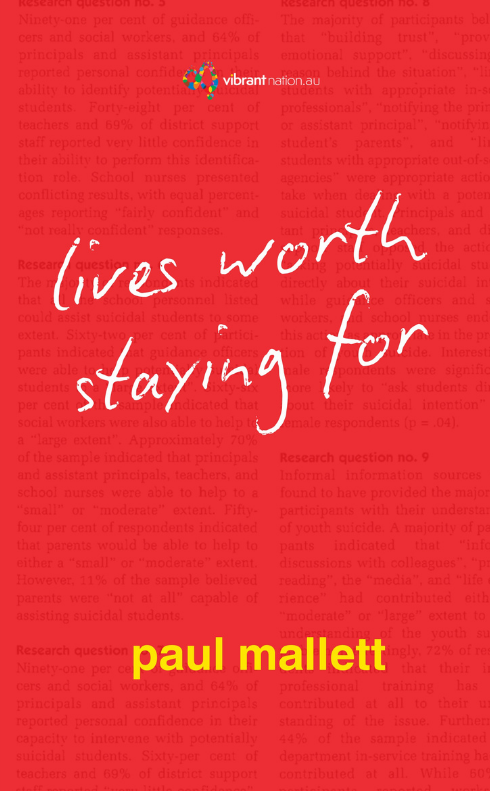
Lives Worth Staying For is a faithful reproduction of a youth suicide prevention thesis written in 1996, and a reflective essay written thirty years on.
Lives Worth Staying For is a unique work that brings together the complete text of paul mallett’s 1996 University of Tasmania Honours thesis on youth suicide prevention with a deeply personal reflection written thirty years later.
At a time when youth suicide was emerging as a major public concern in Australia, mallett examined whether school professionals were prepared to identify, support and refer young people experiencing suicidal distress. His research argued that schools were not simply places of learning, but essential partners in preventing the loss of young lives.
Rather than rewriting or updating the original thesis, mallett reproduces it in full, preserving it as an historical record of the questions, evidence and thinking that shaped the beginning of his career. The second half of the book reflects on what followed: three decades working across homelessness, children and families, disability, health, education, workforce development and public policy; the suicide of a close friend; the evolution of prevention-first thinking; and the conviction that societies should consciously organise themselves around the goal of creating lives worth staying for.
More than a book about suicide, Lives Worth Staying For is a book about hope, responsibility and system design. It argues that suicide cannot be understood solely as an individual tragedy, but must also be examined through the conditions in which people are born, grow, learn, work, connect and live. Prevention is not simply the work of clinicians. It is the shared responsibility of families, schools, communities, governments and public institutions.
Drawing together research, lived experience and three decades of practice, this book challenges readers to move beyond crisis response and towards upstream action. It asks what kind of society we would build if we measured our success not simply by economic growth, but by whether people experienced belonging, dignity, purpose and hope.
For educators, health professionals, policy makers, researchers, students and community leaders, Lives Worth Staying For offers both an important historical contribution and a compelling vision for the future. It is a reminder that behind every statistic is a human life, and that prevention begins long before a person reaches crisis.
Part memoir, part research, part policy reflection, this book is an invitation to imagine, and help build, a society where every person has the opportunity to live a life worth staying for.