Mayoral Candidate Calls for New Approach to Civic Leadership Through Community Wellbeing Survey, Kanamaluka Convention, City Deal for Kids, and Stronger Care Workforce
Ahead of October’s council elections, paul mallett has outlined a vibrant city vision for the City of Launceston built around four proposals: an annual Community Wellbeing Survey, a regional Kanamaluka Convention, a City Deal for Kids and a Regional Care Workforce Training Hub.
LAUNCESTON, TASMANIA, 24 July 2026: City of Launceston mayoral and councillor candidate paul mallett has unveiled an ambitious model of civic leadership centred on evidence, collaboration and long-term prevention, arguing that local government can play a far greater role in strengthening communities than is often recognised.
Mr mallett brings a distinctive perspective to that argument. For more than thirty years he has observed the work of the City of Launceston Council, spending countless hours in the public gallery and engaging directly with Council processes under successive Mayors Beams, Peck, Lees, Waddle, Dickenson, Dean, van Zetten, Gibson and the current Mayor. Combined with three decades working across the care economy, those experiences have shaped his belief that Council achieves its greatest impact not only through the services it delivers, but through their ability to convene, advocate and build partnerships.
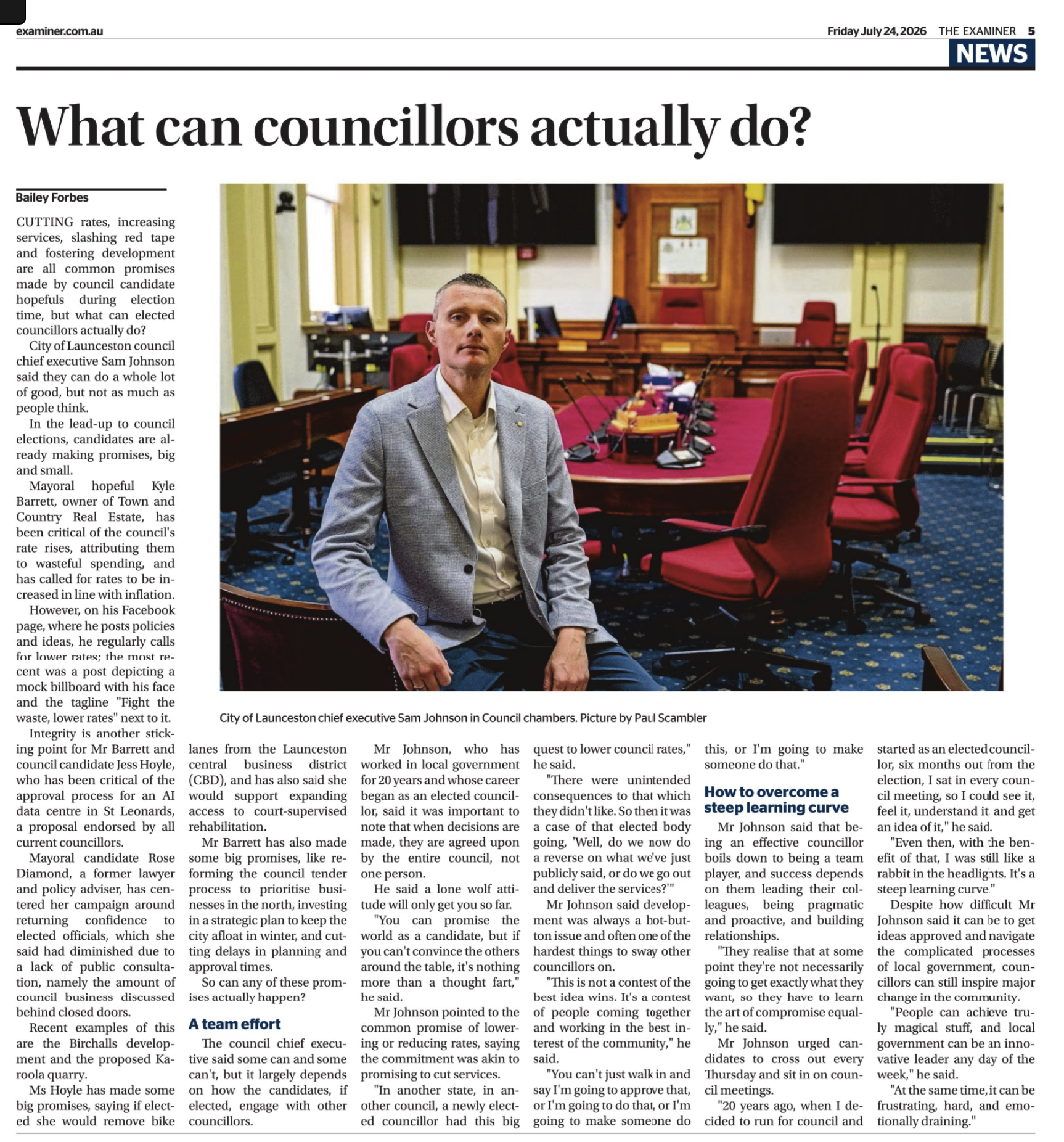
Responding to this week’s discussion (Examiner, 24 July 2026) among mayoral candidates about the role of local government, Mr mallett said councils must continue to deliver the services residents rely upon every day, while also embracing their unique capacity to bring people together around shared priorities and practical action.
“People rightly expect Council to get the local work right through sound financial management, responsible planning and well-maintained roads, parks and public spaces. Those responsibilities matter enormously and they should always be delivered well. But I believe we underestimate what local government can contribute if we think that is where its role ends. Council must also seek to get the big things done,” Mr mallett said.
“The Mayor of Launceston cannot solve housing affordability alone, reform the health system, build every social home our region needs or fix the education system. Those responsibilities sit elsewhere. What a Mayor can do is bring together the people and organisations capable of creating change, build consensus around the evidence and advocate with one strong regional voice.
“That convening role is local government’s comparative advantage. Council works every day with residents, businesses, community organisations, educators, health services and neighbouring councils. My vibrant city vision is not for Council to take over responsibilities that belong elsewhere. It is for Council to become the region’s most trusted convener, helping people solve problems together and ensuring our advocacy is informed by evidence rather than assumption,” Mr mallett said.
Mr mallett said this approach reflects what he calls kind politics. “Kind politics is not soft politics. It is the disciplined use of power to reduce suffering, increase dignity, tell the truth, and design systems that do not abandon people,” he said.
To support that approach, Mr mallett is proposing that the City of Launceston establish an annual Community Wellbeing Surveyto provide a consistent picture of how people are experiencing life across the municipality and the broader Launceston Tamar Valley.
“We know a great deal about the condition of our physical assets. We should know just as much about the wellbeing of the people those assets exist to serve.”
Mr mallett pointed to the City of Greater Geelong’s Preventative Health Survey as proof the model already works. Geelong surveys ten thousand households across every suburb, tracking twenty wellbeing indicators from loneliness and mental health to safety and belonging, and publishes the results on a public dashboard year after year. “Geelong shows this can be done, and done well. If we want to know whether Launceston is becoming fairer, healthier and more connected, suburb by suburb, we need to start measuring it the same way.”
Mr mallett said the Community Wellbeing Survey would become the foundation for an annual civic assembly, the Kanamaluka Convention, bringing together local government, Aboriginal organisations, community groups, businesses, educators, researchers, health services, philanthropy and representatives of the Tasmanian and Australian Governments to review the evidence, agree shared priorities and publicly commit to action.
“Communities rarely lack goodwill. More often they lack a common table around which people can examine the evidence together, decide what matters most and coordinate their efforts. The Kanamaluka Convention would create a disciplined annual process for listening, learning, agreeing and acting together.”
Each Convention would conclude with a small number of agreed regional priorities, clear statements about who is leading each piece of work and an annual public report on progress.
Mr mallett said one of his first priorities as Mayor would be to work with neighbouring councils across the Launceston Tamar Valley to explore how the Community Wellbeing Survey and Kanamaluka Convention could become genuinely regional initiatives, recognising that people’s lives do not stop at municipal boundaries.
“Our economy is regional. Our labour market is regional. Our housing market is regional. Our health system is regional. The opportunities and pressures affecting families do not suddenly change when someone crosses a council boundary. Many of the issues we face are shared, and our response should reflect that reality.”
Mr mallett said the same philosophy underpins his proposal for a City Deal for Kids, bringing together governments, educators, businesses, sporting clubs, cultural organisations and community groups around a shared commitment to improve outcomes from conception through to young adulthood.
When around one in four children in the Launceston region start school developmentally vulnerable, when almost half don’t finish Year 12, and when too many find the door into good work harder to open than it should be, we are missing the talents and contributions our kids can make to this city. Combined with the many young people who leave and do not return, we have every reason to build a vibrant city for kids.
“I have spent much of my working life catching children and families at the bottom of the cliff,” Mr mallett said. “The vibrant city vision is about building the fence at the top, and we will need the State and Commonwealth governments to put their tool belt on to help us build it.”
Mr mallett said he would advocate for a City Deal for Kids, bringing all three tiers of government together around a shared commitment to improve outcomes from before birth into young adulthood.
“Launceston already knows what it looks like when all three tiers of government commit to a shared vision. We built a City Deal for the city centre. We can use the same model to invest upstream in the conditions that allow every child to succeed, rather than continuing to pay downstream through child protection, crisis mental health and youth justice.”
Mr mallett said the same philosophy also underpins his proposal for a Regional Care Workforce Training Hub. Launceston’s care economy, spanning early learning, disability support, aged care, health and family services, already employs eleven thousand people, more than any other industry in the city, and it cannot find the workers it needs.
“The care economy is the workforce that enables the rest of our local economy to function. If people cannot access early learning, aged care, disability support or healthcare, they cannot participate fully in work or community life. That is why growing our care workforce is an economic priority as well as a social one.”
He said a Mayor could convene neighbouring councils, training providers, employers and the Tasmanian and Australian Governments to coordinate training and pathways into care work, positioning Launceston as the training hub the Tamar Valley will need to meet rising demand over the next decade.
“We do not need another report telling us the workforce is short. We need coordination, and a Mayor is well placed to convene it,” he said.
Mr mallett said the proposals are practical, affordable and capable of being implemented within the existing role of local government. They do not seek to expand Council into areas of State or Commonwealth responsibility. Instead, they recognise that councils have an important leadership role in helping communities understand themselves, build partnerships and advocate effectively for investment.
“Throughout my career I have worked across homelessness, child and family services, community development, financial hardship, disability, mental health and workforce reform. One lesson has remained constant. Lasting change happens when communities share ownership of both the problem and the solution.”
“We spend a great deal of time debating what councils cannot do. I think it is time we spent more time talking about what they can do. They can listen. They can convene. They can advocate. They can build partnerships. They can bring evidence into public conversation. They can help communities solve problems together. Those are not secondary responsibilities. They are central to building a vibrant city.”
Mr mallett said his vision is for Launceston to become Australia’s leading regional example of prevention-first civic leadership, where decisions are informed by evidence, success is measured by improvements in people’s lives and collaboration becomes part of the city’s civic culture.
“We have inherited an extraordinary city. It is beautiful, generous and full of potential. It is also a city facing significant challenges that cannot be solved by any one organisation acting alone. My belief is that we can love this city honestly enough to celebrate what is working while also confronting what is not. We can choose to become a city that plans further ahead, works more closely together and invests earlier in the things that matter most.”
Mr mallett closed with a line from his own writing: “A vibrant community does not happen by chance. It is made, and remade, by the promises we choose to keep, and by the future we choose to build together.”
“The role of Mayor is to help bring a community together around a shared future. To lead a council that gets the local, street-level work right, and partner with others to get the big things done. That is the kind of civic leadership I am offering.”
Vibrant City Platform Elements Summary:
- Annual Community Wellbeing Survey for the City of Launceston and Launceston Tamar Valley.
- Annual Kanamaluka Convention to agree regional priorities and coordinate action.
- City Deal for Kids from before birth through young adulthood.
- Regional Care Workforce Training Hub.
- Annual public reporting on agreed priorities and progress.
- Regional partnerships with neighbouring councils.
[ends]
____________
Note to editors: The candidate’s name, paul mallett, is styled in lowercase deliberately and should be reproduced as written. This is not a typographical error.
About the candidate
paul mallett is a Launceston-based social policy author, systems thinker, and community services leader with more than thirty years of experience across homelessness, housing, children and family services, disability, aged care, early learning, and the care economy.
He is the author of vibrant city, a story of Launceston’s future told from 2064, a community leader looking back across four decades of change alongside a young data guardian verifying his account. Chapter by chapter, it imagines a Launceston that works, cares, moves, lifts its kids, creates and celebrates, and grows as a city in a garden. He proposes creating a freshwater Tamar Lake, a second river crossing built for walking and cycling from day one, a cradle-to-career system for every child, and a city-wide movement for health and belonging. It is not a fantasy of a perfect city. It is a civic provocation, a way of asking whether the place we already love could become fairer, kinder, more confident, and more vibrant.
He is also the author of vibrant state, vibrant nation, The Kind Politics Playbook, Lives Worth Staying For, and the Vibrant Leadership Series of policy blueprints: A State of Good Health, A Home for Everyone, Affordable Warmth, Every Child Succeeds, and “It’s the Care Economy, Stupid!”. He founded vibrantnation.au to share practical reform ideas for more vibrant communities.
Media enquiries
paul mallett
Email: paul.mallett@vibrantnation.au
Mobile: 0450 24 24 24
Website: vibrantnation.au
Location: Launceston, Tasmania