A vibrant city does not happen by chance. It is made, and remade, by the promises we choose to keep, and by the future we choose to build together.
A vibrant city does not happen by chance. It is made, and remade, by the promises we choose to keep, and by the future we choose to build together.
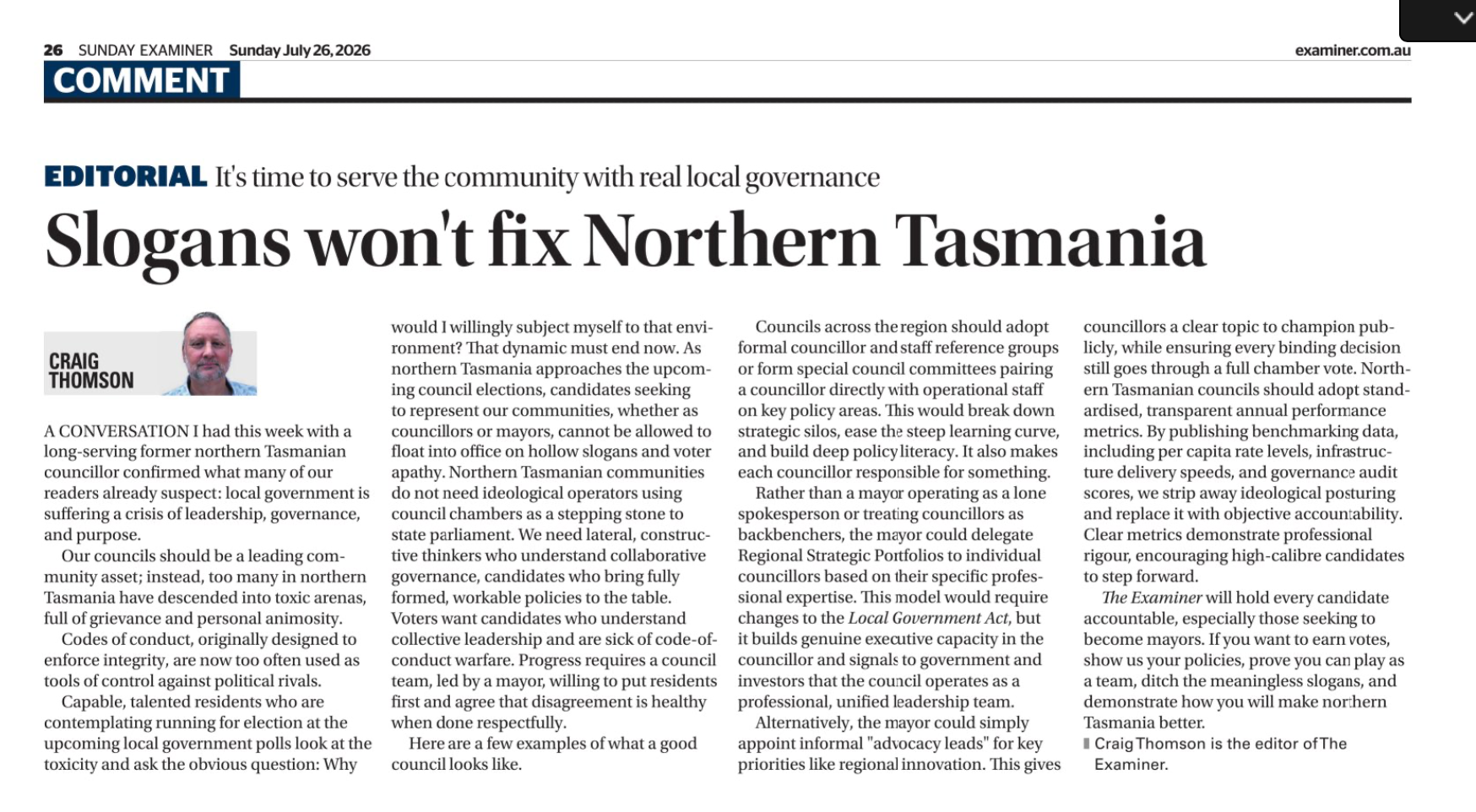
In reply to Craig Thomson’s editorial, “Slogans won’t fix Northern Tasmania” (The Examiner, 26 July 2026).
To the people of Launceston,
Craig Thomson’s editorial this weekend argues that local government in Northern Tasmania faces a crisis of leadership, governance and purpose. I think he is close to the mark. It is an uncomfortable diagnosis, but an honest one. Too often we have reduced local government to personalities instead of principles, conflict instead of collaboration, and short-term argument instead of long-term stewardship. Recognising the problem, however, is only the first step. Elections are not simply about changing who occupies the chairs around the council table. They are about deciding what those chairs are for. Before we ask who should lead our city, we should first ask what kind of city we are trying to build together.
Leadership is not measured by the volume of someone’s voice, their social media reach, or the sharpness of their criticism. It is measured by whether they help people work together around a shared future. Governance is not about bureaucracy for its own sake. It is about making decisions that are transparent, evidence-informed, accountable and worthy of public trust. Purpose is the question that should sit behind every budget, every planning application, every footpath, every sporting ground, every grant decision, and every community investment. Does this help build a better life for the people who call Northern Tasmania home? If we lose sight of that question, we can manage a council efficiently while still falling short of our purpose: improving the lives of the people we are elected to serve.
I’ve been in and around local government since 1991. Over more than thirty years I’ve sat in the City of Launceston’s public gallery for hundreds of hours, watched councils through the leadership of ten mayors, and led delegations on behalf of people who don’t always get invited to the table: vulnerable children and families, people sleeping rough, families facing financial hardship, and many others. Those years taught me something important. Leadership is not about having all the answers. It is about bringing people together around shared evidence, shared priorities and shared responsibility. No mayor changes a city alone.
My approach to public service has also been shaped by more than thirty years working alongside people experiencing homelessness, family violence, mental ill-health, financial hardship, disability and community disadvantage, and by work across aged care, public education, early learning and care, and child safety. Those experiences taught me that the biggest problems rarely begin as crises. They begin much earlier, when opportunities are missed, when support arrives too late, when systems become fragmented, or when communities stop believing they can shape a better future together. They also taught me that lasting change almost never comes from one person, one program or one election promise. It comes when communities decide to work together around a common purpose. That is why I came to a simple conclusion: local government matters more than most people realise because it shapes the places where everyday life happens.
That is why I am standing for Mayor and Councillor, and why I will continue to talk about kind politics. Not because politics should be soft, but because it should be disciplined in the way it uses power. Kind politics rejects performative outrage and the false choice between compassion and competence. It asks leaders to be servant leaders, to tell the truth, listen respectfully, use evidence honestly, disagree without contempt and measure success by whether people’s lives become better, not whether political points are scored. Kindness is not weakness. It is a standard of leadership that expects power to be exercised fairly, transparently and in the long-term interests of the whole community.
It is also why I believe the defining question of this election is a simple one: What would it take to build a more vibrant city together? A vibrant city is not simply one with balanced budgets and well-maintained roads, important though those responsibilities are. It is a city where children get the best possible start, where older people remain connected, where people with disability belong, where creativity is recognised as civic infrastructure, where local businesses can thrive, where homelessness is prevented rather than managed, where warm homes reduce illness, and where every person has the opportunity to contribute to community life. That is the purpose I believe local government should serve.
That’s why I’ve taken what I know is an unusual approach to this election. Instead of asking people to judge me on flyers, social media posts and campaign slogans, I’ve published the thinking behind my campaign before asking for a single vote. Every one of my books will be available online, free to read before the election, at vibrantnation.au.
vibrant city is the story: what a more vibrant Launceston could look like by 2064. The Kind Politics Playbook is the method: leadership built on fairness, evidence and respect rather than hardness or spectacle. Two further books, Our Almost Nearly Perfect Vibrant City and The State of Our Most Vulnerable People Report, will be released on 1 September and set out my election platform and the evidence behind it.
The remaining books address the social challenges that have shaped my work over many years: vibrant state, vibrant nation, Affordable Warmth, Every Child Succeeds, A State of Good Health, “It’s the Care Economy, Stupid!”, A Home for Everyone and Lives Worth Staying For. Together, they ask how governments, communities, services and industry can work together to create warm homes, support children from cradle to career, prevent illness, strengthen care, end homelessness and prevent suicide before people reach crisis.
None of that is a claim to have all the answers. It is an invitation to examine my thinking, challenge it, improve it and judge whether I am prepared for the responsibility I am asking the people of Launceston to entrust to me. I do not claim certainty. I am taking responsibility: for the ideas I have put forward, for the mistakes I am bound to make, and for the willingness to be corrected in public rather than defended in private.
Craig Thomson’s editorial is right. Slogans aren’t good enough. If you’re asking people to trust you with public office, they should be able to see not only your conclusions, but how you reached them. My hope is that showing my working across those books is one small contribution to the different kind of politics he is asking for. A vibrant city does not happen by chance. It is made, and remade, by the promises we choose to keep, and by the future we choose to build together.
With thanks,
paul mallett
Prospective Candidate for Mayor and Councillor, City of Launceston
vibrantnation.au