I believe our politics can be kinder without becoming weaker, more thoughtful without losing resolve, and more ambitious without becoming arrogant. Kindness isn’t the absence of strength. It is a choice about how we use it.
I believe our politics can be kinder without becoming weaker, more thoughtful without losing resolve, and more ambitious without becoming arrogant. Kindness isn’t the absence of strength. It is a choice about how we use it.
In reply to Bailey Forbes, “Is ‘kindness politics’ enough to get elected?” (The Examiner, 10 August 2026).
To the people of Launceston,
The Examiner asked a fair question this morning: is “kindness politics” enough to get elected? I don’t know. That is up to you. But I do know what I mean when I talk about kind politics, and why it sits at the heart of the kind of leadership I want to bring to our city.
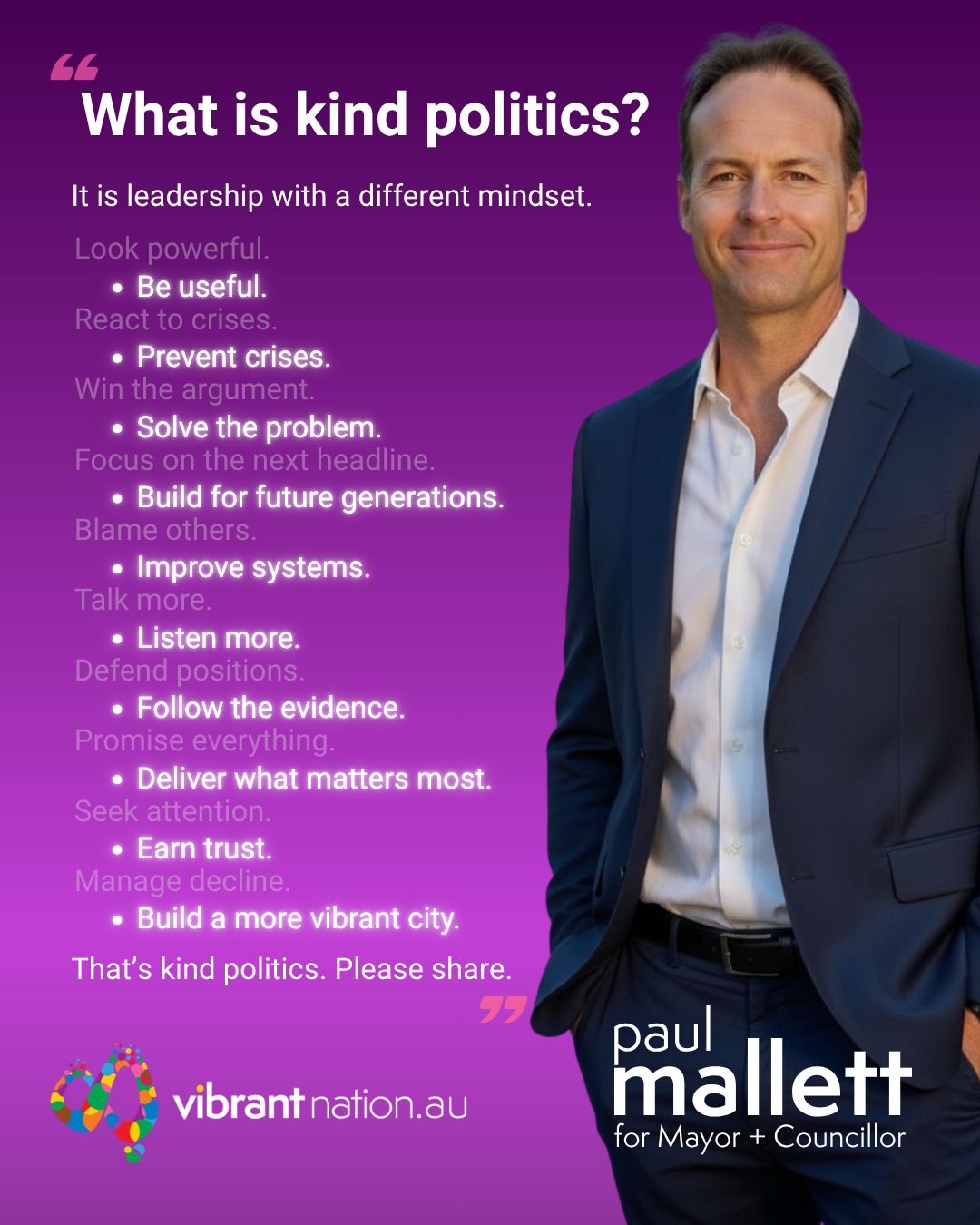
Kind politics isn’t about being nice all the time. It isn’t soft politics, and it certainly isn’t avoiding hard decisions. It is about what we choose to do with power. Do we use it to serve, or to control? Do we listen before we decide? Do we tell people the truth, including when the answer is difficult? Do we bring people into decisions that affect them? Do we wait until people are in crisis, or work upstream to prevent harm in the first place?
I have spent thirty years working in community services alongside people doing it tough. I have seen what happens when systems arrive too late. I have seen people blamed for circumstances much bigger than themselves. And I have seen what becomes possible when people listen carefully, work together and act early. That experience has shaped the kind of leadership I believe in.
For me, kind politics means:
- listening first, because you cannot represent people well if you don’t understand their lives;
- telling the truth about what can be done, what cannot be done and why;
- sharing power, because people affected by decisions should have a genuine hand in shaping them;
- acting upstream, rather than continually paying to manage problems after the damage has been done;
- following the evidence, being willing to change course when something isn’t working; and
- being accountable by making commitments, reporting back and admitting mistakes.
It also means thinking beyond ourselves. We are temporary custodians of this city. The decisions we make today should serve the people who live here now, while leaving Launceston stronger for the people who will inherit it from us. That is why I talk about the idea of a 100-year chair in the Council chamber: a reminder to look beyond the next meeting, the next budget and the next election.
None of this means avoiding disagreement. Sometimes leadership means saying no. Sometimes kindness means challenging something that is unfair, wasteful or harmful. Sometimes it means making a difficult decision that not everyone will like. We can be firm without being cruel. We can disagree without making someone our enemy. We can be ambitious without pretending we have all the answers.
Kind politics is not an idea I invented. It draws on long traditions of practical wisdom, servant leadership, ideas of reciprocity and collective responsibility, restorative practice, participatory democracy, prevention and stewardship. At its heart is a simple proposition: compassion and competence are not opposites. Kindness without competence achieves too little. Competence without humanity can do enormous harm.
I explore these ideas more deeply in The Kind Politics Playbook: Vibrant Leadership for Changemakers. In that book I describe kind politics as an “always-on” way of leading: using power for public good, combining empathy with evidence and ethics, acting upstream, sharing power and recognising that how we do politics matters just as much as what we achieve.
But writing books is the easy part. The real test is how we behave when somebody disagrees with us. Whether we listen when it would be easier to dismiss. Whether we tell the truth when spin would be easier. Whether we share credit. Whether we admit when we are wrong. Whether we keep showing up when the work becomes difficult. And whether, when somebody gives us power, we remember what that power is for.
I am not asking the people of Launceston to believe I will always get everything right. I won’t. I am asking you to judge me by how I go about the work: whether I listen, tell the truth, follow the evidence, work with others, act early, report back and use whatever power I am entrusted with to help build a fairer, healthier, more connected and more vibrant city.
So, is kindness politics enough to get elected? We’ll find out. But whether I am elected or not, I believe our politics can be kinder without becoming weaker, more thoughtful without losing resolve, and more ambitious without becoming arrogant. Kindness isn’t the absence of strength. It is a choice about how we use it.
With thanks,
paul mallett
Prospective Candidate for Mayor and Councillor, City of Launceston
vibrantnation.au
ps. And to those I failed with unkindness, I am sorry. I carry it and keep learning.