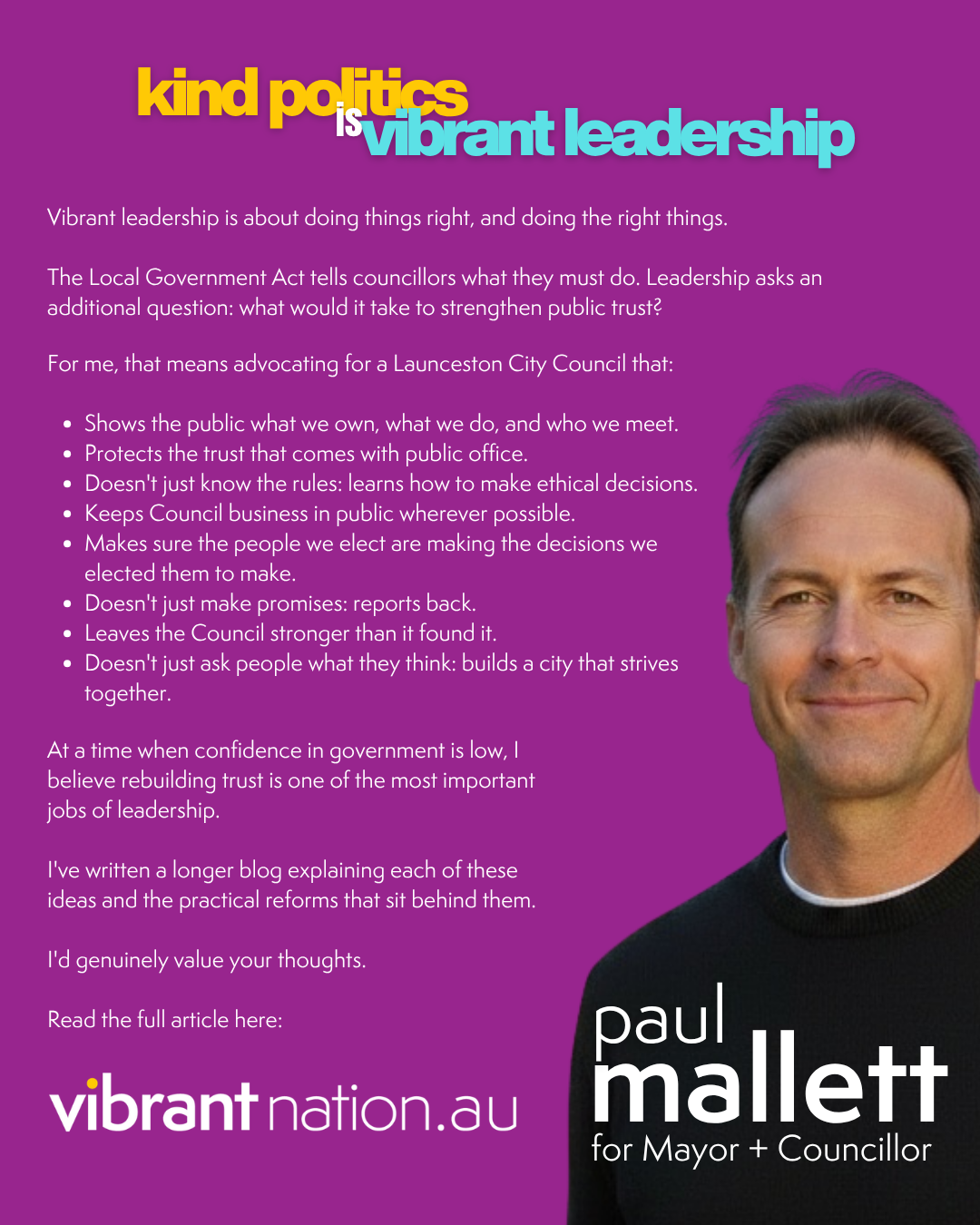
Kind politics is vibrant leadership, it’s doing things right, and doing the right things
To the people of Launceston,
Kind politics is not soft politics. It is not avoiding difficult conversations. It is not lowering standards. It is not letting poor behaviour slide.
I believe kind politics is built on vibrant leadership. And vibrant leadership is about doing things right, and doing the right things. They are not the same thing.
The Local Government Act sets out how councils must operate and how councillors must behave. Those standards matter. They protect the public interest and establish the minimum standard for good governance.
But leadership should never aim for the minimum standard.
Leadership should ask a harder question: what will strengthen public trust?
At a time when confidence in governments and elected representatives is low, I believe one of the most important responsibilities of a councillor is not simply to make good decisions. It is to strengthen the institution itself, and help rebuild public trust and confidence in local government.
That is what I mean by vibrant leadership. It means building a Council where transparency is normal, ethical leadership is expected, accountability is continuous, and community participation is genuine.
Here are some of the practical ways I will advocate for that culture.
1. Show the public what we own, what we do, and who we meet.
The issue: Public trust depends on people being able to see how decisions are made and who is influencing them. Too much governance information is technically public but difficult to find, spread across multiple documents or published long after the event.
My proposal: Live online registers for gifts, hospitality and benefits, updated in real time as declarations are made. Weekly governance updates through Council’s social media channels, and a standing governance summary in every fortnightly Council meeting agenda covering gifts, hospitality, declarations of interest, attendance and other key accountability information. Public diaries, transparent lobbying registers and appropriate public registers of financial interests and assets, with carefully defined exemptions where privacy, safety or legal obligations genuinely require confidentiality.
Why it matters: Transparency should not depend on people knowing where to look. It should be visible, timely, and part of the everyday culture of Council. The easier it is for the community to see what its Council is doing, the easier it becomes to build trust.
2. Protect the trust that comes with public office.
The issue: Public confidence is strengthened when elected representatives demonstrate they are willing to meet standards that go beyond the minimum required by law.
My proposal: Working with Vulnerable People registration for all City of Launceston councillors, given how regularly they meet with children, young people, older people and other vulnerable members of our community. Public reporting of councillor attendance, declarations of interest and other governance measures that demonstrate accountability.
Why it matters: These measures are not about assuming the worst of people. They are about strengthening confidence in public office. Leadership should not simply ask, “What must I do?” It should ask, “What will give the community confidence that I take this responsibility seriously?”
3. Don’t just know the rules. Learn how to make good decisions.
The issue: Ethics is too often treated as a compliance exercise. Read the legislation. Learn the Code of Conduct. Tick the box.
My proposal: Every councillor should undertake ethics training at the beginning of each Council term, and complete an annual refresher. More importantly, ethics should be treated as a practical discipline, not an academic one. Difficult decisions are rarely solved by simply applying a rule. They require reflection, judgement, and a willingness to weigh values, relationships, consequences, duties, fairness and the public interest. I would also like to explore providing councillors with access to an independent ethics advisory service, such as Ethi-call, where difficult ethical questions can be discussed confidentially before they become public controversies.
Why it matters: We should not wait until something goes wrong before talking about ethics. We should build a culture that supports thoughtful, ethical decision-making every day. Good judgement is not accidental. It can be strengthened through reflection, conversation and continual learning.
4. Keep Council business in public wherever possible.
The issue: The community deserves confidence that important public decisions are being debated openly. Over the past two decades, the City of Launceston has come a long way. I was one of the early advocates, alongside Jeremy Ball, for live streaming Council meetings. Today those meetings are streamed live and available for the community to watch. That is a significant step forward.
My proposal: The next conversation should be about Council workshops. Workshops play an important role in helping councillors understand complex issues, receive briefings and test ideas. I am not suggesting they should disappear. But if much of the debate and consensus-building occurs before matters reach the Council chamber, we should have a mature conversation about whether there are opportunities to increase transparency while preserving the legitimate purpose of workshops. Likewise, decisions made in confidential session should remain limited to matters where confidentiality is genuinely necessary under the law.
Why it matters: Public confidence depends not only on the decisions Council makes, but on how those decisions are reached. Wherever possible, Council business should remain public business.
5. Make sure the people we elect are making the decisions we elected them to make.
The issue: Every Council inherits governance arrangements from the Council before it. Over time, delegations of authority to the CEO/General Manager and Council officers can simply continue without careful review.
My proposal: At the beginning of every Council term, elected councillors should formally review the delegations granted to the CEO/General Manager and Council officers. The question should not be whether officers are doing a good job. The question should be whether the balance is right between decisions that belong with elected representatives and those appropriately delegated to professional staff.
Why it matters: Every newly elected Council receives its own democratic mandate from the community. Governance arrangements should reflect that mandate, not simply continue because they existed last term. Leadership means consciously deciding where accountability should sit.
6. Don’t just make promises. Report back.
The issue: Too often, councils ask for community feedback, announce projects or make commitments, and people never hear what happened next. Consultation can become a one-way conversation.
My proposal: I want Council to get into the habit of writing receipts. If Council asks the community for ideas, it should come back and explain what it heard, what it acted on, what it chose not to act on, and why. Likewise, when Council commits to an action or project, the community should be able to follow progress through simple public dashboards and regular reporting.
Why it matters: Accountability is not simply about publishing information. It is about demonstrating progress, explaining decisions, and showing people that their time, ideas and lived experience genuinely influenced the outcome. Good leadership closes the loop.
7. Leave the Council stronger than you found it.
The issue: Election campaigns naturally focus on the projects we want to deliver for the city. We spend much less time asking how we will strengthen the institution responsible for delivering them.
My proposal: Every Council should aim to leave behind stronger governance, a healthier organisational culture, better relationships, better decision-making systems and higher levels of public trust than it inherited. Success should not be measured only by roads built, parks upgraded or buildings opened. It should also be measured by whether the Council itself has become a stronger, more trusted institution.
Why it matters: Infrastructure matters. Services matter. But institutions matter too. Good councillors don’t simply build a better city. They leave behind a better Council, capable of serving the community well long after individual councillors have moved on.
8. Don’t just ask people what they think. Build a city that strives together.
The issue: Too much community engagement happens after proposals are largely developed, or only once every four years during an election campaign. Consultation can become something Council does to the community rather than with the community. Too often, people generously contribute their ideas and lived experience, but don’t hear what became of them.
My proposal: I want to strengthen civic participation by investing in representative, high-functioning consultative committees that genuinely reflect the diversity, skills and lived experience of our community. I want Council to use evidence-informed community engagement that helps people understand issues, contribute thoughtfully and participate respectfully. I also support a regular Community Wellbeing Survey, so we measure not only roads and rates, but how people are actually experiencing life in our city.
I also believe the time has come to establish the Kanamaluka Convention: an annual civic gathering where residents, community organisations, businesses, researchers, service providers and governments can come together to review progress, identify emerging challenges, celebrate what is working, and agree on shared priorities for the years ahead.
Most importantly, whenever Council asks people to participate, it should write receipts: reporting back on what it heard, what it acted on, what remains outstanding, and why.
Why it matters: Strong communities don’t simply elect representatives. They participate. The best ideas rarely belong to one person, one political grouping or one Council. They emerge when a city listens well, learns together, strives together, and shares responsibility for its future.
None of these ideas is about creating more bureaucracy. None of them is about assuming the worst of councillors. None of them is about catching people out. They are about designing a Council where transparency is normal, ethical leadership is expected, accountability is continuous, and community participation is genuine.
Good governance isn’t about catching bad decisions or poorly behaving councillors after the damage is done. It’s about designing a Council where doing the right thing becomes the easiest thing to do.
I believe kind leadership is about how we treat people. I believe vibrant leadership is about building institutions that people can trust.
At a time when confidence in governments and elected representatives is low, that matters more than ever. If we want a kinder politics, we need vibrant leadership. If we want vibrant leadership, we need councillors prepared to go beyond the minimum standard set by the law, and choose higher standards because they strengthen public trust.
That is the culture I want to help build. That is the Council I want to help strengthen.
And that is what I mean when I talk about kind politics. It is vibrant leadership in action.
With thanks,
paul mallett
Prospective Candidate for Mayor and Councillor, City of Launceston
vibrantnation.au