
A vibrant city doesn’t seek to manage homelessness better. It seeks to end it.
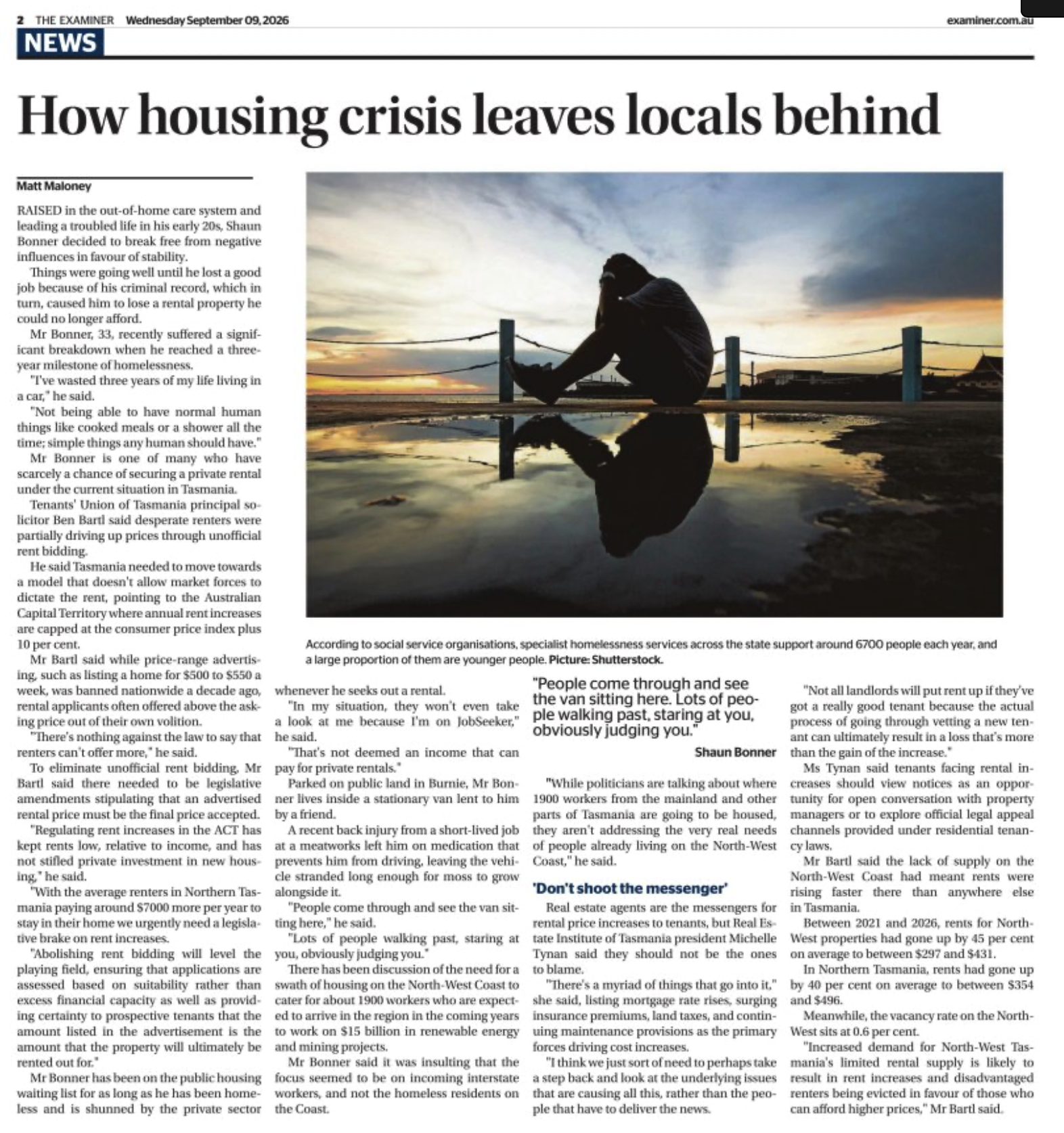
This letter was prompted by The Examiner’s reporting on Tasmanians priced out of the rental market, 8 September 2026, and a social media discussion thread started on 27 September 2026.
To the people of Launceston,
A recent story in The Examiner should trouble us. It tells of a 33-year-old man who grew up in out-of-home care and is now living in his vehicle. He found work, turned his life around and secured a rental, but lost his home after his criminal record cost him his job and income.
He has now been homeless for three years. He has sought help, remained on housing waiting lists and complied with what has been asked of him. Still, he has no home. He lives without the ordinary things most of us barely think about: a kitchen, a shower, privacy, security and somewhere safe to sleep.
We can read this as one person’s misfortune. Or we can ask a harder question. Why do we have a housing system capable of allowing someone to remain homeless for three years, despite asking for help and doing what the system requires?
Before I continue, I want to be very clear about what follows. This is a critique of the system, not the people who work within it. I have deep respect for those working across housing and homelessness services. They are among the unsung champions of our communities, doing difficult and vital work with care, persistence and humanity, often while carrying the consequences of decisions made far upstream. I suspect many would gladly see their own role become unnecessary if it meant homelessness had genuinely been ended. That says something important about both the work they do and the future we should be trying to build.
Homelessness can often be prevented
I spent years working in homelessness services here in Launceston, first responding to people already in crisis and later working in family homelessness prevention. Because of that work, I believe homelessness is rarely one event. It usually develops through a series of pressures we can often see coming: a rent increase, relationship breakdown, family violence, a lost job, leaving care or prison, poor health or an income shock.
When there is enough housing, enough support and someone responds early enough, those events do not have to become homelessness. When those protections are missing, people fall.
That prevention-first logic runs through three of my books. A Home for Everyone sets out a blueprint for ending homelessness in Tasmania. The State of Our Most Vulnerable People 2027 is the evidence report. Its homelessness and housing stress chapters draw heavily on 2021 Census data because that remains the most detailed local data available, but the pattern they describe is entirely consistent with what we are seeing across Launceston now and hearing in community conversations: too many people without a safe and secure home, and too many more living one rent rise, interest rate rise, lost job, illness, separation or unexpected bill away from losing theirs. One chapter looks at what happens after housing has been lost. The other looks at the point just before, when prevention is still possible. Our Almost Nearly Perfect Vibrant City then brings that evidence and upstream thinking into local government and asks what a prevention-first Council might actually do.
All three books are available as free PDFs during this election campaign. I want people to be able to read the work, test the ideas and judge for themselves what sits behind my candidacy.
The ambition running through that work is deliberately bigger than managing homelessness a little better. We should work together to end it. Where homelessness cannot be prevented, it should be rare, brief and non-recurring.
Rare means preventing far more people from losing their homes. Brief means moving quickly from homelessness into permanent housing. Non-recurring means people are not returned to the same instability that caused homelessness in the first place.
Housing first, not housing eventually
A home should not be something a person earns after demonstrating that they are sufficiently stable, healthy, employed or compliant. A home is what makes stability possible. Without somewhere secure to live, maintaining employment becomes harder. Recovering from illness becomes harder. Keeping children settled in school becomes harder. Addressing mental ill-health or addiction becomes harder.
That is why Housing First matters. The proposition is straightforward: provide a safe, permanent home first, then build whatever health, employment, mental health, financial or social supports a person needs around that stable foundation.
The alternative is asking people to put their lives back together while sleeping in a car, moving between couches or wondering where they will sleep tomorrow night. Crisis accommodation matters enormously when somebody needs somewhere safe tonight, but it should be a short bridge to a permanent home, not somewhere people remain because no permanent option exists.
Prevent the next person becoming homeless
Ending homelessness is not only about responding after somebody loses a home. It also means acting earlier so fewer people lose one in the first place. This is where my years working in homelessness prevention continue to shape my thinking. Too often our systems respond after rent arrears have hardened into eviction, after the tenancy has collapsed, after the family is in emergency accommodation or after somebody arrives at a homelessness service.
That is failure demand. We spend heavily responding after harm has become more expensive, more complicated and more damaging, when earlier action might have prevented much of it.
In The State of Our Most Vulnerable People 2027, I argue that housing stress is one of the clearest prevention points available to us. A household may still have an address, but be one rent rise, illness, separation, job loss or unexpected bill away from losing it. Waiting until a notice to vacate arrives is waiting too long.
One practical response would be a dedicated tenancy sustainment approach across the Launceston Tamar Valley, bringing together housing providers, financial counsellors, landlords, real estate agents and other supports so that rent arrears or housing debt trigger early help rather than the beginning of a countdown to eviction.
The measure of success should not simply be how many people entered a service. It should be how many households stayed housed.
The same principle applies to predictable institutional exits. People should not leave hospital, custody, out-of-home care or crisis accommodation without safe accommodation arranged. We already know many of the pathways into homelessness. Prevention means designing those transitions so that people are not dropped into it.
We need a sh!t tonne more homes
We cannot promise Housing First if there are no houses. Australia needs substantially more social and affordable housing, but I also think we need to be willing to discuss some bolder structural reforms at State and Commonwealth levels. A Home for Everyone deliberately goes beyond asking government to fund another round of projects. It asks how we build a housing system in which affordable supply grows and remains affordable over generations.
One proposal I make is a third housing market: a permanent, non-speculative affordable housing sector sitting alongside social housing and the private market. It would provide secure, income-linked rental and non-speculative ownership options for people caught in the middle, including key workers, families, older renters and others who may never qualify for social housing but are increasingly priced out of the private market.
The key is permanence. Homes would stay affordable from one household to the next through mechanisms such as Housing Trusts, binding affordability rules and capped returns, so affordable housing accumulates over time instead of repeatedly reverting to full market price.
That requires institutions capable of holding housing for public purpose over the long term. A Home for Everyoneproposes Housing Trusts that can acquire and retain land and homes in perpetuity, so public investment accumulates rather than repeatedly starting again. It also argues for restoring a permanent State construction capability, including a Department of Construction able to build, repair and upgrade housing according to need when private markets cannot or will not deliver enough.
And we should have a much bigger conversation about patient capital. Australia has enormous pools of long-term savings, including superannuation, looking for stable long-term investment. If suitable housing investment vehicles existed, with proper safeguards and reasonable returns, I would happily tick a box on my own superannuation to direct some of it towards permanently affordable Australian housing. The point is not to raid retirement savings or ask people to sacrifice returns. It is to ask whether some of our long-term capital can earn an appropriate return while helping build long-term housing infrastructure.
These are deliberately bold ideas. They require State and Commonwealth leadership, serious design work and public debate. But the principle underneath them is simple: instead of repeatedly paying to recreate affordability, we should build institutions, housing and investment models that allow affordable supply to accumulate over time.
What can local government do?
The Commonwealth controls major taxation, income-support and investment levers. The State Government carries primary responsibility for housing and homelessness services. Local government cannot end homelessness alone, and it should not pretend otherwise.
But local government is not powerless. Council knows place. It understands neighbourhoods, infrastructure, planning pressures, development patterns and the local organisations already doing the work. The Mayor and Council also have an important convening role. They can bring people together, help create common purpose and make a stronger case to the levels of government that hold the biggest levers.
We also need an honest local conversation about how the housing we already have is being used. That should include the impact of short-stay accommodation on long-term rental supply, and whether some form of levy or differential charge on short-stay accommodation should be explored. We should also examine what can reasonably be done about homes that remain persistently unoccupied in the middle of a housing shortage, including whether vacancy-related rates, levies or other incentives are legally and practically available to local government, or require State Government action. I am not suggesting we rush to a predetermined answer. I am saying these questions are serious enough that we should examine them properly rather than declare them off limits.
Launceston already has a Homelessness Advisory Committee, and important work has been done through it. I would like to see that committee reinvigorated and broadened, with people who have lived experience, homelessness services, Aboriginal community-controlled organisations, community housing providers and government agencies sitting alongside builders, developers, planners, landholders, investors and others capable of increasing housing supply.
Prevention and supply need to be part of the same conversation. We cannot rapidly rehouse people into homes that do not exist.
I would also like to see a stronger place-based partnership for Greater Launceston, bringing Commonwealth, State and local government together with community organisations, housing providers, business and people with lived experience around one shared outcome: fewer people becoming homeless, less time spent homeless, more people moving into permanent housing and fewer people returning to homelessness.
That should be accompanied by better local measurement. We should know whether the number of people entering homelessness is rising or falling, how long people remain homeless, whether they return to homelessness after being housed, how many tenancies are being sustained, and whether people are leaving institutions without somewhere safe to live.
Where appropriate and with strong privacy protections, we should also explore the by-name approaches being used elsewhere, so that people do not disappear into aggregate statistics while responsibility passes from one service to another. If somebody spends three years homeless, our systems should see those three years as three years, not as a collection of disconnected service episodes.
Put the ambition into our regional plans
I would like the ambition to make homelessness rare, brief and non-recurring reflected in the Greater Launceston Plan. Housing markets, employment, infrastructure and services extend across council boundaries. A regional commitment would give councils and their partners a stronger foundation for cooperation, land-use planning, housing supply and shared advocacy.
That intent should then be translated into specific requests to the Tasmanian and Commonwealth Governments through Council’s advocacy work. Simply asking for “more housing” is not enough. We should be able to name what we are seeking: Housing First, tenancy sustainment, safe institutional exits, permanently affordable housing, appropriate use of public land, stronger housing supply, better local data and a formal place-based partnership for the region.
Council’s contribution is not to become a housing department or duplicate the work of others. It is to use the powers it genuinely has: to convene, plan, facilitate, partner and advocate.
Measure what actually matters
One of the ideas running through all three books is that governments and services can become very good at counting activity without necessarily answering the most important question: are people actually better off? We can count funding, programs, referrals, assessments, contacts, applications and nights of crisis accommodation. Those things matter, but they are not the outcome.
The outcome is whether somebody has a safe, secure and affordable home.
For Launceston, the questions I would want us to keep asking are simple. Are fewer people becoming homeless? When homelessness occurs, are people homeless for less time? Are more people moving into permanent housing? Are fewer people returning to homelessness? Are more households receiving help before they lose their homes?
Those measures would tell us whether we are genuinely turning the curve.
A shared ambition for Launceston
My argument for a more vibrant Launceston has never been about making the city look better while leaving hardship untouched.
A vibrant city is about how well people are able to build a life here, participate, contribute and belong. It is about the quality of our streets and parks, our culture and creativity, our neighbourhoods and economy, but it must also be about how we respond when people are struggling and what we do upstream to prevent that struggle becoming crisis.
Nobody should spend years living in a vehicle while governments count programs, applications, referrals and waiting lists. The measure that matters is whether the person has a home, and whether the next person at risk receives help early enough that they never lose theirs.
We know how to prevent many evictions. We know how to rehouse people rapidly. We know the logic of Housing First. We know we need substantially more social and permanently affordable housing. We know crisis accommodation works best as a bridge rather than a destination. And we know that homelessness is experienced locally even when many of the biggest policy levers sit elsewhere.
The challenge is to bring those pieces together around an ambition large enough for the problem.
I believe Launceston is the right size and has the right people to prevent homelessness wherever we can, and to end it quickly when it occurs. Tasmania could aspire to become the first jurisdiction in Australia to end homelessness, with Launceston playing a constructive and appropriately humble part in that shared effort.
Three years living in a vehicle should never become normal. Homelessness should never be accepted as inevitable simply because it has existed for a long time.
The deeper argument in A Home for Everyone is that what has been designed can be redesigned. Prevention must become the organising principle. Housing must be treated as essential infrastructure. Crisis responses should be humane but brief. Exits from care, custody and hospitals should be safe by design. Tenancies should be protected when life changes. Local places should matter. Lived experience should help guide the work.
Ending homelessness is not a destination we reach once and then forget. It is an ongoing practice of prevention, stewardship, humility and care. It requires governments willing to hold responsibility rather than deflect it, communities willing to think long term, and all of us willing to reject the quiet assumption that homelessness is simply something we have to live with.
We know the problem closely, and we have the people, organisations and capability to do something meaningful about it. We can prevent more people from becoming homeless. We can make homelessness shorter when it occurs. We can build systems that help people stay housed. And we can contribute to a Tasmania that no longer accepts homelessness as inevitable.
That is work worthy of us.
We can build a city, and a state, committed to a home for everyone.
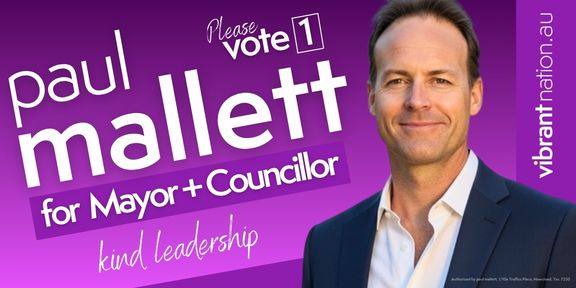
paul mallett
Candidate for Mayor and Councillor
City of Launceston
vibrantnation.au